

Introduction: The Ultimate “Analog” Escape on the Water
In an era dominated by relentless digital notifications and screen saturation, “analog hobbies”—tactile, presence-demanding experiences—are seeing a quiet revolution. Sailing and boating sit at the absolute pinnacle of this movement. With no screens required and no technology in sight beyond a magnetic compass or a VHF radio, taking to the water forces a skipper to focus entirely on wind shifts, atmospheric cues, and immediate surroundings, effectively tuning out the noise of daily life.
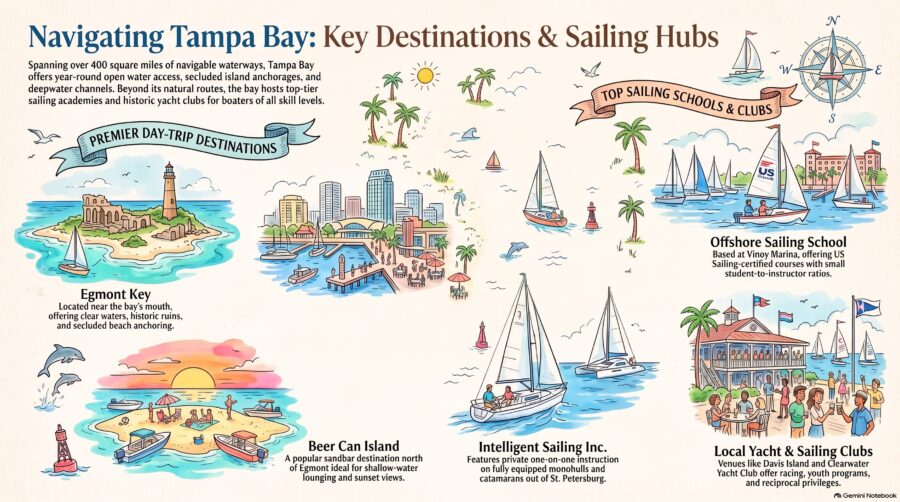
Few places offer a more dynamic theater for this escape than Tampa Bay. Spanning over 400 square miles of open harbor, intricate channels, and sheltered inlets, it is one of the largest natural harbors in the United States. From shore, the bay presents an inviting, frictionless sheet of blue that looks simple to navigate.
However, taking the helm reveals a far more nuanced coastal ecosystem. Beyond its idyllic surface, Tampa Bay features wind-driven water level swings, submerged historical hazards, strict commercial transit rules, and an evolving maritime culture. Whether you are a seasoned coastal cruiser or a novice eager to take your first tiller, here are six essential realities every boater should know about navigating these waters.
1. Northerly Blows Can Drain Marinas (and Trap Your Boat)
While summer in Tampa Bay is famous for its predictable rhythm of intense afternoon thunderstorms—occurring on roughly 50 to 85 days annually, predominantly from June through September—winter introduces a powerful counter-dynamic. Strong atmospheric cold fronts sweeping down from the north bring sustained, cold offshore winds that fundamentally reshape the bay’s hydrodynamics.
During these prolonged winter northerlies, heavy winds literally push water out through the bay’s southern entrance into the Gulf of Mexico. This atmospheric pressure and wind force can depress water levels across Tampa Bay by up to 4 feet below normal chart datum, while delaying high tide times by as much as three hours. For boaters moored in shallow marinas along the bay’s eastern shore, these winter blows can drain slips entirely, leaving hulls resting in mucky silt and trapping vessels at their docks for days at a time. Conversely, sustained southwest winds produce the exact opposite effect, piling water into the bay to raise levels by 4 feet and accelerating high tide by up to an hour.
“In the winter the tides are lower and when strong northerly blows it may empty the Bay further. There may be 2 or 3 days a year when nobody can get in or out of their marinas.” — Benny, Sailboat Owners Forum
For local boaters, understanding wind-driven water displacement is often far more critical than checking standard astronomical tide charts. While routine lunar tides average a modest 1 to 3 feet, seasonal wind events easily override predictions, turning marked channels into mudflats or inundating low-lying piers without warning.
2. Passage Key and Guano Racks: Historical Hazards Beneath the Water
Tampa Bay’s sparkling sandbars and barrier islands draw thousands of boaters every weekend, but some of its most appealing anchorages conceal physical remnants from Florida’s military and industrial past.
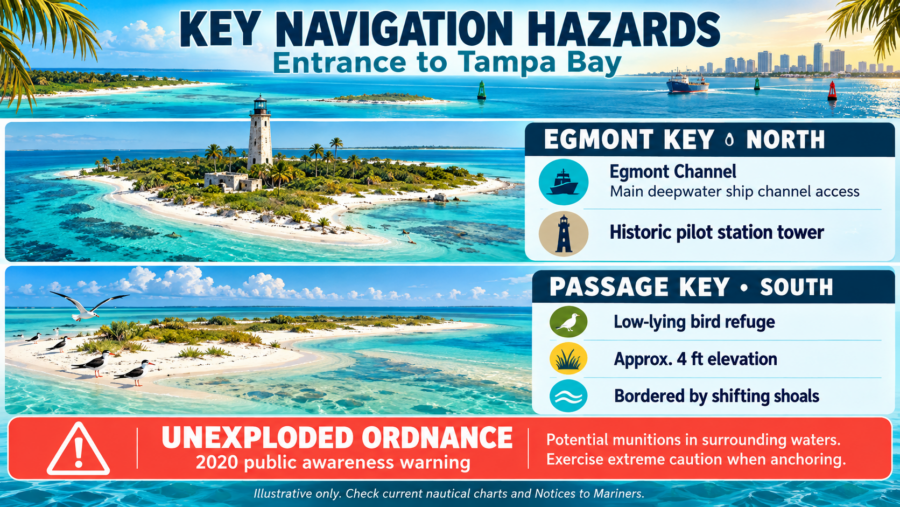
At the mouth of Tampa Bay, just south of Egmont Key, sits Passage Key—a low, barren sand spit roughly 0.3 miles long that rises barely 4 feet above high water. While wildly popular for shallow-water lounging, the surrounding shoals and breakers carry a serious hidden risk: official marine notices issued in 2020 formally warned mariners of unexploded ordnance scattered in the shallow waters surrounding the key, requiring strict caution when setting anchor or wading.
Further north along the Gulf coast between Tampa Bay and Apalachee Bay, boaters encounter another unusual historical hazard: decaying wooden bird guano racks. Originally constructed on outermost shoals as large square platforms set on pilings roughly 20 feet above the water, several of these abandoned structures were broken apart during mid-century aerial gunnery practice. Today, they leave behind jagged, submerged timber piling that is not always charted, posing a distinct hull-puncturing risk to shallow-draft vessels cutting across outer shoals.
The picturesque sandbars of the Suncoast frequently mask a utilitarian past. Recognizing that modern anchorages overlap with former military practice ranges and forgotten commercial infrastructure is essential for maintaining a safe margin of seamanship.
3. Under the Sunshine Skyway: Big Ships Can’t Dodge Recreational Craft
Spanning lower Tampa Bay with a soaring 180-foot vertical clearance, the Sunshine Skyway Bridge frames the primary gateway for commercial cargo ships, fuel tankers, and cruise liners. Dredged to federal project depths of 43 to 45 feet, the main shipping channel enables deep-draft vessels drawing over 39 feet to reach commercial ports in Tampa, Port Manatee, and Big Bend. Yet, dangerous close calls between small recreational craft and commercial freighters remain a persistent threat near the bridge span.
MARITIME REGULATION CALLOUT
Navigation Rule 9b (Narrow Channels): “A vessel of less than 20 meters in length or a sailing vessel shall not impede the passage of a vessel which can safely navigate only within a narrow channel or fairway.”
Recreational boaters routinely misjudge the approach speed of large ships. Due to their immense scale, freighters create an optical illusion, appearing to glide slowly when they are actually transiting at speeds exceeding 12 knots. At that momentum, a loaded vessel requires vast distances to maneuver or stop, and it cannot alter course outside the narrow, dredged channel without running aground. Under Navigation Rule 9b, small craft under 65 feet (20 meters) and sailboats are legally obligated to yield early to restricted commercial traffic.
Overcoming the visual illusion of a freighter’s speed is a vital safety skill. Because a 600-foot ship fills the horizon, its relative speed is difficult to gauge from a small cockpit, making early, unambiguous alterations of course the only sensible option for a recreational skipper.
4. Condos vs. Reciprocity: The Real Truth About Yacht Clubs
Along the Tampa Bay shoreline, dozens of high-rise residential developments and retail marinas append “Yacht Club” to their building signboards as a marketing flourish. Experienced local boaters, however, draw a clear line between waterfront real estate developments and authentic, member-owned yacht clubs.
Legitimate clubs across the region are accredited by the Florida Council of Yacht Clubs (FCYC). Membership in an FCYC-affiliated club unlocks reciprocal privileges statewide, granting cruising skippers seamless access to private dining facilities, transient slips, and guest moorings throughout Florida. Notable traditional clubs around the bay include:
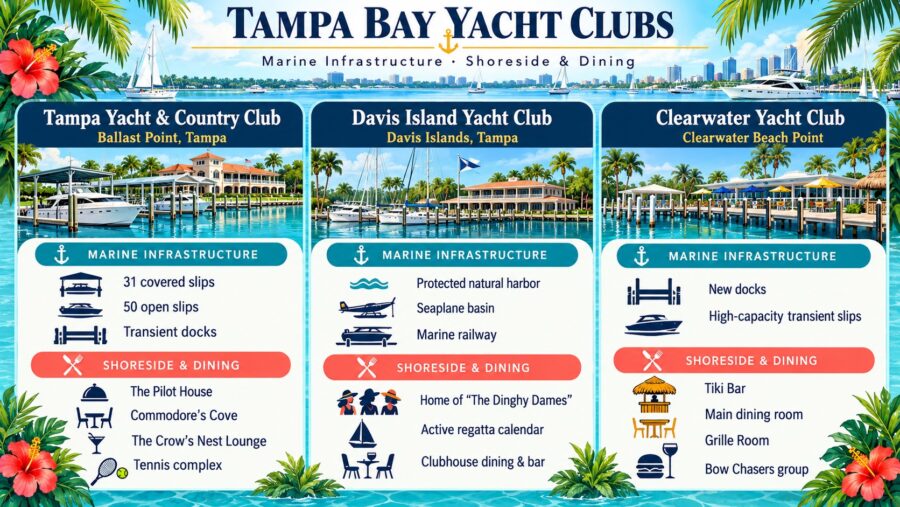
Joining a genuine yacht club is less about social prestige and more about practical cruising access. Reciprocal slip rights, private staging basins, and member-maintained haul-out infrastructure turn traditional clubs into invaluable hubs for navigating Florida’s waterways.
5. One-on-One Luxury and Private Charters are Overhauling Sailing Schools
Historically, learning to sail meant enrolling in a crowded group class, sharing a cramped, decades-old boat with five or six strangers, taking brief turns at the tiller, and enduring spartan cabin conditions. Modern sailing education in St. Petersburg and Tampa has abandoned this outdated model, shifting toward highly customized, high-comfort instruction.
Leading institutions like Intelligent Sailing Inc. (operating out of Harborage Marina in St. Petersburg) and Offshore Sailing School (based at the historic Vinoy Resort & Marina) have completely updated the learning experience:
- Low Ratios and Private Coaching: While standard regional schools often pack up to 6 students on a boat, Offshore Sailing School strictly caps its resort classes at a maximum of 4 students per instructor. Taking customization even further, Intelligent Sailing specializes exclusively in true 1-on-1 private coaching—reserving the entire yacht for an individual, couple, or private family group alongside a dedicated captain.
- Luxury, Modern Fleets: Training takes place aboard brand-new, modern monohulls and high-performance cruising catamarans (such as Leopard 42/45s or Seawind 1160s). These vessels offer upscale amenities, including fresh-water electric flush heads, multi-cabin layouts, and icy-cold air conditioning.
“Don’t make the mistake of sailing on a smelly old boat and never sailing again.” — Intelligent Sailing Inc.
By replacing cramped, worn-out instruction vessels with modern, well-appointed yachts, local sailing academies have converted what used to be an intimidating, uncomfortable learning curve into an enjoyable lifestyle experience.
6. Boat Wakes—Not the Wind—Create the Roughness
Because Tampa Bay is sheltered from open Gulf of Mexico swells by barrier islands like Sand Key, Long Key, and Mullet Key, newcomers often expect glassy conditions inside the harbor. However, high-traffic zones inside the bay regularly produce a surprisingly sharp, uncomfortable cross-chop.
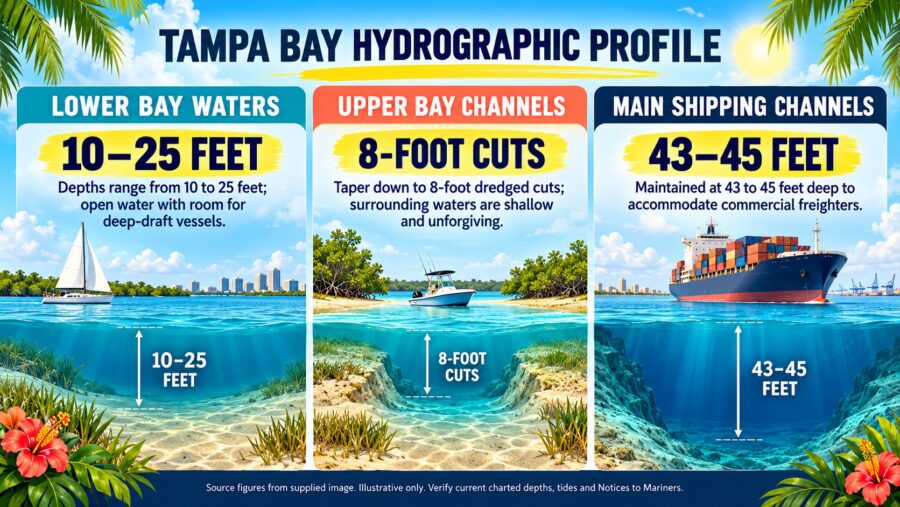
In busy channels, this chop is generated by engine horsepower rather than wind velocity. Heavy commercial tugs, deep-draft freighters, and high-speed motor yachts push huge displacement wakes that bounce off seawalls, causeways, and shallow channel edges, creating messy wave energy. Furthermore, while lower bay waters average 10 to 25 feet deep, upper bay channels drop off rapidly outside dredged 8-foot cuts. Cruising sailboats drawing 5 feet or more must watch their depth sounders closely. Local forum contributor Ross in Tampa, who sails his 1979 Oday 25 Lola, warns never to cut corners on channel markers due to constant shoaling, noting that in shallow-draft boats, you will often feel the shoal drag in the tiller before the keel actually strikes bottom.
Managing a smooth ride inside Tampa Bay relies less on reading offshore weather charts and much more on anticipating traffic density, respecting shallow boundaries, and heeding local knowledge regarding channel markers.
Conclusion: The Open Horizon Ahead
Navigating Tampa Bay is a deeply satisfying pursuit that blends dynamic seamanship with a rich coastal lifestyle. From calculating wind-driven tide shifts and respecting deep-water shipping lanes to avoiding hidden historic hazards and stepping aboard modern sailing fleets, mastering these local realities reveals the absolute best of Florida’s largest harbor.
Whether you plan to embark on an afternoon anchor-out, apply for membership at a reciprocal yacht club, or step aboard a modern catamaran for private, one-on-one sailing lessons, there is no better time to reset your daily routine. Isn’t it time to put down the screen, step onto the deck, and experience Tampa Bay from the water?
