

 1. Introduction: The Dream vs. The Reality of Boating in Tampa Bay
Living in the Tampa Bay area offers unmatched access to some of the finest marine environments in North America. Whether navigating the scenic urban stretches of the Hillsborough River, cutting through John’s Pass toward the open Gulf of Mexico, or dropping anchor off Shell Key to watch a Gulf Coast sunset, the marine lifestyle is a primary driver for local real estate buyers and relocating residents. However, transforming the marine dream into a sustainable reality requires separating emotional aspirations from operational metrics.
Enjoying Tampa Bay boating effectively comes down to an essential economic choice: do you want to “pay for a boat” as an asset owner, or “pay for boating” through structured access models and memberships? While owning waterfront homes with boat docks shapes the economic equation, the vast majority of your annual outlay and lifestyle satisfaction will depend on how you choose to access the water itself. This guide evaluates the complete financial equation, comparing direct ownership, dry stack storage, boat clubs, private charters, and private dock infrastructure across Pinellas, Hillsborough, and Manatee counties.
2. What Does It Really Cost to Own a Boat in Florida? (The Cold, Hard Numbers)
2.1 Is Boat Ownership Miscalculated?
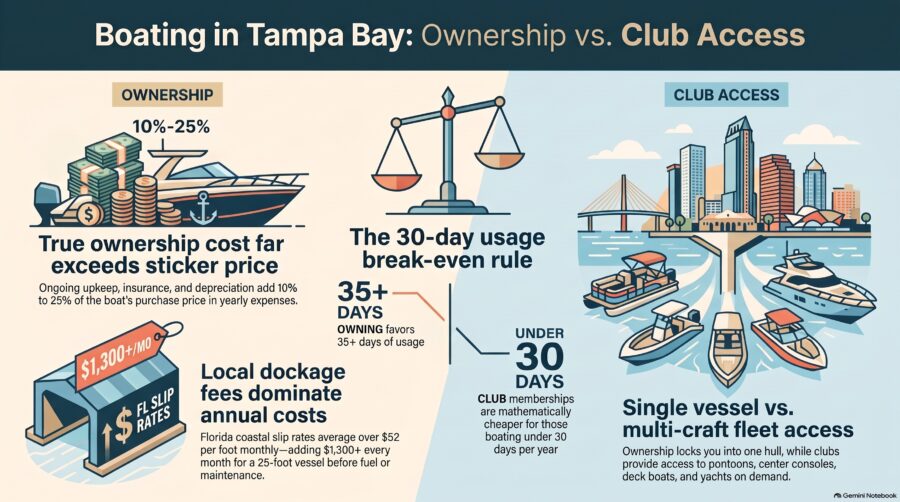
Boat ownership is systematically miscalculated because first-time buyers focus almost exclusively on the initial purchase price or monthly loan payment. In reality, the sticker price represents only a starting point. Recurring operational expenses, localized marina fees, aggressive marine maintenance, and non-cash asset depreciation accumulate rapidly, creating an all-in expenditure profile significantly higher than most buyers anticipate.
2.2 The “10% Rule” and What It Actually Covers
A standard marine benchmark is the “10% rule of thumb,” which posits that annual vessel upkeep costs roughly 10% of the boat’s current market value. As noted by BoatOut, this maintenance calculator serves as a widely recognized baseline for mechanical upkeep. However, analysis from Foreland Marine cautions that relying strictly on the 10% rule can be misleading, as actual expenditures fluctuate wildly based on hull length, age, engine configuration, and environment.
Crucially, prospective buyers must distinguish between base maintenance and total cost of operational readiness:
- What the 10% Baseline Covers: Ongoing routine mechanical servicing, oil changes, fluid flushes, unexpected wear-and-tear repairs, electrical fixes, and consumable gear replacements.
- What the 10% Baseline Excludes: Marina slip rentals, dry stack storage, comprehensive hull and liability insurance, statutory state registration, county property taxes, loan interest, and asset depreciation.
The Saltwater Surcharge
- In Florida’s sub-tropical marine environment, operational upkeep routinely pushes toward the higher end of the 10%–12% range. Unlike freshwater environments, Tampa Bay’s high-salinity waters require relentless preventative care:
- Corrosion Management: Engine cooling systems require regular freshwater flushes, manifold and riser replacements every 3–5 years, and frequent sacrificial zinc anode replacements.
- Bottom Growth & Hull Care: Vessels kept in wet slips demand periodic barnacle scraping and anti-fouling bottom painting every 12 to 18 months (500–1,200 annually).
- UV & Gelcoat Degradation: Florida’s year-round sun bakes gelcoat and marine vinyl, requiring frequent compounding, waxing, and upholstery conditioning to prevent steep cosmetic devaluation.
2.3 Depreciation, Financing, and the All-In Expenditure Checklist
When a vessel is financed, capital costs stack on top of operational expenses. Financial analysis from BoatCalcs indicates that combining marine loan interest (typically 7% to 8%) with early-stage vessel depreciation (averaging 5% to 8% annually in initial years) creates an effective annual carrying expenditure of 20% to 25% of the purchase price.
To establish an accurate operational budget for Florida boat ownership costs, buyers must account for the primary marine expenditure categories validated by National Marine Manufacturers Association (NMMA) industry standards:
- Maintenance & Servicing: Engine maintenance, bottom painting, mechanical repairs, and detailing.
- Storage & Dockage: Marina wet slips, dry stack storage, or private dock maintenance.
- Fuel: Marine-grade rec fuel (89+ octane) or off-road diesel based on engine burn rates.
- Insurance: Comprehensive marine liability, hull coverage, and windstorm riders.
- Taxes & Registration: State sales tax, local discretionary surtaxes, and statutory length-based registration.
- Interest: Financing costs over the loan term.
Synthesizing the 5-Year Ownership Reality
To understand the true cash flow and wealth impact of boat ownership, consider the math across two documented cost scenarios:
- Direct Operational & Financing Spend ($50,000 Vessel): According to financial data synthesized by Slipstream Boating, purchasing a 50,000 recreational vessel results in **80,000 to $100,000 in total cash outlay over 5 years**. This includes loan principal/interest payments, routine maintenance, marine insurance, and local storage fees.
- All-In Capital Outlay & Asset Value Loss ($40,000 Vessel): Financial analysis from Carefree Boat Club shows that a $40,000 initial purchase price requires $47,450 to $53,650 in Year 1 alone (factoring in 6%–7% sales tax, registration, trailer costs, safety gear, and initial commissioning). Over Years 2 through 5, ongoing operational costs average 16,650 annually (66,600 total), plus $5,000 to $10,000 in major repairs or gear upgrades. Combined with $15,000 to 20,000 in early-stage depreciation loss, the total 5-year financial impact reaches 136,600 to $146,600.
The Hidden Time Commitment Beyond cash flow, direct vessel ownership demands a major time commitment. Industry data reveals that private boat owners spend 72 to 114 hours per year on non-boating operational tasks. This includes pre-trip engine checks, post-trip freshwater flushes, hull washdowns, trailering, coordinating repair service, annual haul-outs, and hurricane contingency prep.
3. Florida & Tampa Bay Local Reality Check: Marinas, Storage, and Registration
3.1 Florida Boat Registration Fees (Statutory Rates)
In Florida, recreational vessel registration fees are established strictly by length class under Florida Statutes §328.72. Collected through county tax collectors, sample statutory base fees include:
- Class A-1 (Vessels under 12 feet): $5.50 for a 12-month period.
- Class A-2 (12 feet to under 16 feet): $16.25 for a 12-month period.
- Class 1 (16 feet to under 26 feet): $28.75 for a 12-month period.
- Class 2 (26 feet to under 40 feet): $78.25 for a 12-month period.
While state registration fees scale with vessel length, they represent the smallest line item in your overall budget—dwarfed by municipal dockage fees, local sales taxes, and insurance premiums.
3.2 Local Slip Rates & Storage: Tampa Bay Marinas & Pinellas County
Dockage rates in coastal Florida represent one of the single largest recurring fixed costs of vessel ownership. Documented municipal and regional rates highlight current market realities:
- Clearwater Municipal Dockage: A staff-recommended slip rental rate of $53.27 per foot/month, based on a Spring 2025 regional market study.
- City of Miami Municipal Marinas: $52.00 per foot/month (effective late 2025).
Sample Monthly Slip Calculation (25-Foot Vessel) 25 feet X $52.00 – $53.27 per foot/month = $1,300.00 – $1,331.75. This yields an annual baseline fixed cost of $15,600 to $15,982 per year strictly for the right to tie off at a dock—incurred regardless of whether the boat leaves the slip.
Key Local Marine Infrastructure & Service Footprint
Navigating Tampa Bay requires understanding municipal slip availability, fuel logistics, and dealership hubs:
- Marjorie Park Yacht Basin (City of Tampa): Located on Davis Islands at the mouth of the Hillsborough River, this facility offers immediate access to downtown Tampa and upper Tampa Bay. It features 32 monthly slips for permanent tenants (which maintain an active waiting list). Transient docking rates are $2.00 per hour (up to 4 hours), $2.00 per foot per day, or $7.15 per foot per week (plus tax). Dockside fuel options include off-road diesel and mid-grade recreational gasoline sold at direct cost plus 40%.
- Thunder Marine Footprint: A landmark regional dealership network serving Pinellas and surrounding counties for over 40 years. Key operational facilities include their main showroom at 8701 Bay Pines Blvd in St. Petersburg, specialized service/parts at 4701 95th St in St. Petersburg, and dedicated service infrastructure at 1960 Whitfield Park Avenue in Sarasota. Securing offsite boat storage in Pinellas County through high-and-dry stack facilities or dealer networks provides maintenance support, but adds recurring storage line items to the annual ledger.
4. Boat Clubs vs. Ownership: What Is the Break-Even Reality?
4.1 Defining the Financial Break-Even Point
Determining whether to join a club or purchase a vessel directly comes down to an objective analysis of annual days on the water.
The Fixed Cost Stack vs. Usage Days
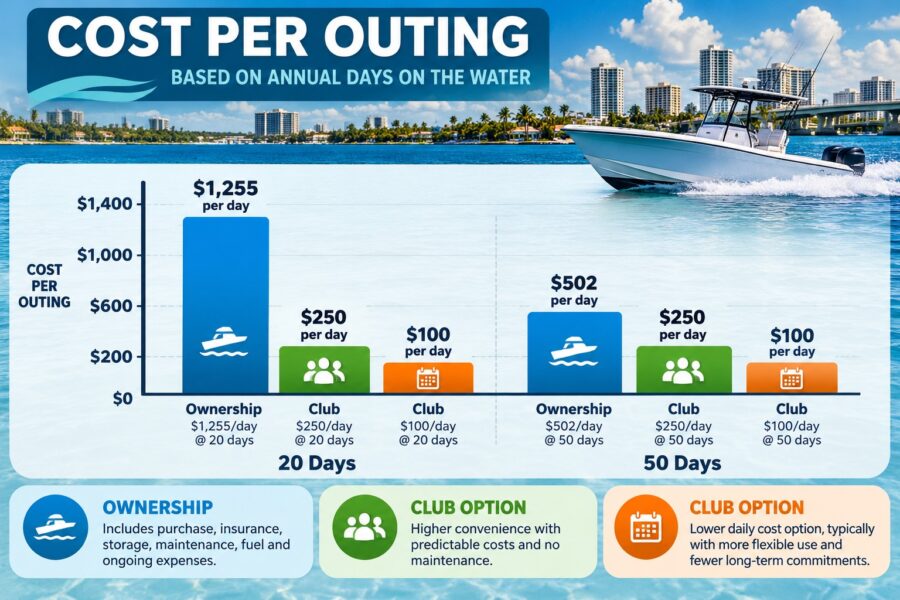
Consider an average 23-to-25-foot recreational boat. Fixed ownership costs—including wet slip rental (15,600), marine insurance (2,500), baseline maintenance (3,000), and financing interest/depreciation (4,000) — total approximately $25,100 per year before buying fuel.
- 20 Days on the Water/Year (Owner): $25,100 / 20 outings = $1,255 per day (excluding fuel).
- 20 Days on the Water/Year (Club Member): $5,000 annual dues / 20 outings = $250 per day (excluding fuel).
Usage Thresholds
- Fewer than 25–30 Days per Year: Joining a boat club or utilizing rental platforms is mathematically far more cost-effective. Shared overhead eliminates dockage, insurance premiums, and non-cash depreciation.
- 35 to 40+ Days per Year: Direct vessel ownership becomes economically rational, provided the owner values custom rigged electronics, spontaneous late-night departures, or has access to a functional private backyard dock.
4.2 Local & Regional Boat Club Options Compared
Detailed Operator Breakdown
National Chains
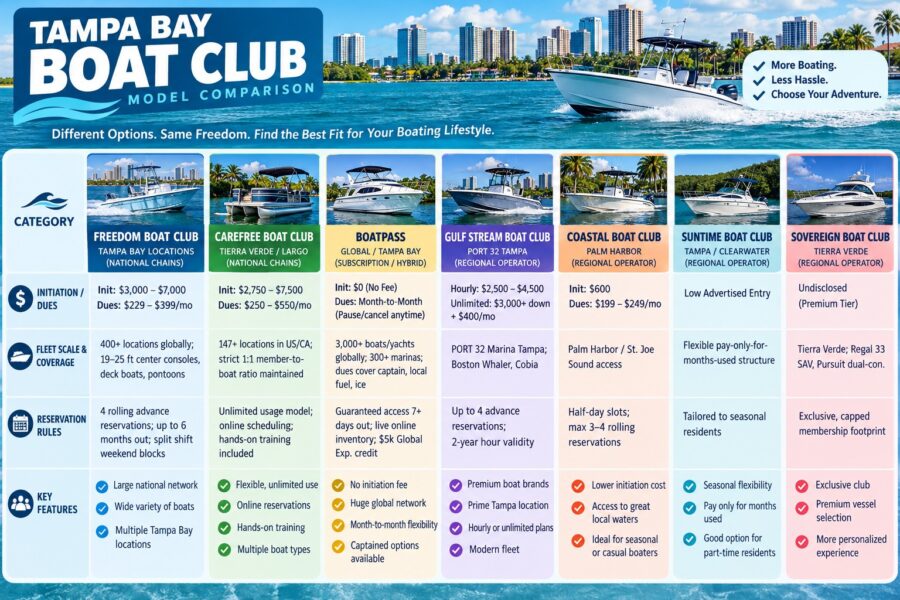
- Freedom Boat Club (Tampa Bay): Operates multiple local docks including Harbour Island Marina in Tampa. Provides reciprocal access across 400+ worldwide locations. Members can hold 4 rolling advance reservations up to 6 months out. Weekend scheduling uses split-shift time blocks (sunrise to 1:00 PM / 2:00 PM to sunset).
- Carefree Boat Club (Tampa/St. Pete/Largo): Locations at Tierra Verde Marina Resort, Tarpon Springs, and Largo. Differentiates itself by maintaining a strict 10:1 member-to-boat ratio, ensuring high weekend vessel availability across its 147+ North American footprint.
Subscription & Hybrid Models
- BoatPass: Represents a modern subscription model with 0 initiation fees and no long-term contracts (true month-to-month, pause anytime). Gives access to 3,000+ boats and yachts across 300+ global marinas. Feature highlights include live online availability, guaranteed vessel availability when booking 7+ days in advance, an annual 5,000 Global Experiences credit for multi-day yacht charters, and inclusive dues that cover licensed captains, local fuel, ice, and water.
Local & Regional Operators
- Gulf Stream Boat Club (PORT 32 Tampa): Positions itself as a premium service featuring high-end brands (Boston Whaler, Cobia, Sportsman) equipped with advanced electronics. Offers hourly plans (2,500–4,500 for 25–50 hours) or 6-month unlimited options ($3,000 down + $400/mo).
- Coastal Boat Club (Palm Harbor): Budget-friendly regional option ($600 initiation, 199–249/mo) offering half-day time slots with direct access to St. Joseph’s Sound. Cancellable with 60 days’ notice.
- SunTime Boat Club & Sovereign Boat Club: SunTime caters to seasonal residents with flexible “pay-only-for-months-used” billing. Sovereign operates an exclusive, capped membership model out of Tierra Verde, utilizing luxury hulls like the Regal 33 SAV equipped with twin 300-hp Yamahas, generators, and cabin air conditioning.
4.3 Boat Club Constraints & “Gotchas” to Watch For
When evaluating boat clubs versus ownership, prospective members must consider operational trade-offs highlighted in consumer feedback:
- Upfront Capital Requirements: Traditional brick-and-mortar clubs charge non-refundable initiation fees ranging from $2,750 to $7,500 before monthly dues.
- Weekend Reservation Congestion: Peak summer weekends, holidays (Memorial Day, 4th of July, Labor Day), and weather windows fill up quickly, often requiring bookings weeks in advance.
- Split-Shift Booking Constraints: Standard club blocks (e.g., 8:00 AM–1:00 PM or 2:00 PM–Sunset) make full-day offshore fishing excursions difficult without burning two reservation slots.
- Fleet Condition & Age Variations: In franchised club operations, maintenance standards and vessel age can vary by dock location, with heavily used club hulls showing cosmetic wear.
5. Alternative Ways to Experience Tampa Bay: Charters, Rentals, and Vessel Selection
5.1 Private Charters & Specialized Watersports
For progressive watersports requiring precise wave shaping and specialized equipment, private captained charters offer an appealing alternative to asset ownership.
Elite Watersports Charter Specs (St. Petersburg)
- Vessel: 25′ Super Air Nautique G25 (featuring up to 5,800 lbs of integrated factory ballast).
- Activities: Wakesurfing, wakeboarding, hydrofoiling/wake foiling, and sunset dolphin cruises.
- Service Model: Includes a USCG-certified captain with 10+ years of instruction experience, accessing butter-flat water training zones in Tampa Bay.
- Capacity & Duration: Private sessions for up to 6 guests, run in 2 to 4-hour blocks—eliminating captain liability, gear costs, and haul-out maintenance.
5.2 Peer-to-Peer Rentals & Choosing the Right Boat Type
For casual boaters on the water fewer than 15 days per year, peer-to-peer platforms like Boatsetter offer on-demand rentals with optional captain services, eliminating recurring monthly dues.
Selecting the right vessel style for local water conditions is critical to a good experience:
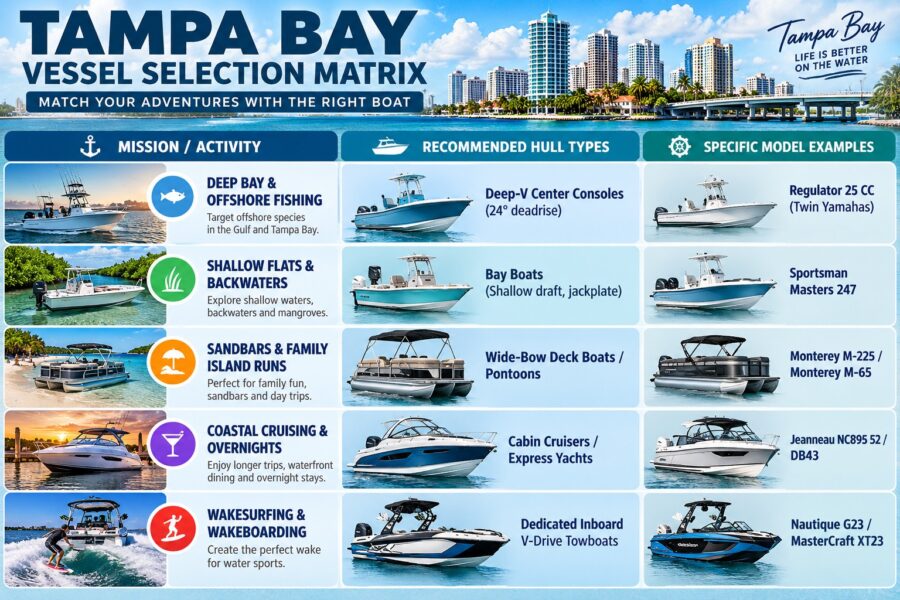
- Fishing the Flats, Bridges, and Open Bay: Crossing open bay chop during an afternoon sea breeze requires a Deep-V center console like the Regulator 25 CC (twin Yamaha engines, 24° deadrise hull, 408-quart fishbox, 46-gallon livewell). For shallow backwater species like snook and redfish, bay boats like the Sportsman Masters 247 feature poling platforms, trolling motor setups, and shallow drafts.
- Sandbar Sundays (Clearwater Beach, Shell Key, Passage Key, Egmont Key, Beer Can Island): Wide-bow deck boats like the Monterey M-225 or Monterey M-65 offer deep cockpit seating for 8 to 12 guests, wide swim platforms, and shallow drafts for beaching near popular sandbars.
- Coastal Cruising (St. Pete to Sarasota or Tarpon Springs): Enclosed cabin cruisers like the Jeanneau NC895 S2 (360-degree glass cabin, dual berths) or the larger Jeanneau DB43 (featuring drop-down side terraces) provide weather protection and overnight accommodations along the Intracoastal Waterway.
- Dedicated Wakeboarding and Wakesurfing: Safe wakesurfing requires inboard V-drive towboats where the propeller is tucked safely under the hull. Industry-leading models from MasterCraft (NXT/XT/XStar), Nautique (G23/Paragon), Malibu (Wakesetter 23 LSV), Axis (A22), Moomba, Heyday, Tige, and Centurion feature integrated surf gates, hydrofoil wedges, and heavy ballast systems to shape clean waves.
6. The Real Estate Perspective: Waterfront Homes with Boat Docks (The 20% Lens)
For real estate buyers in Tampa Bay, purchasing waterfront homes with boat docks dramatically changes the ownership math, but introduces unique property responsibilities.
Private Backyard Dock vs. Commercial Marina Storage
Private Backyard Dock:
- Pros: Instant spontaneous access; zero monthly commercial slip fees ($15,000+ annual savings); seamless loading/unloading from your home.
- Cons: Boat lift maintenance; severe storm/hurricane exposure; winter negative low tide depth limits; seawall maintenance responsibilities.
Commercial Marina Slip / Dry Stack:
- Pros: Professional storm management and haul-out services; deep water access regardless of tide; no seawall or lift upkeep.
- Cons: High recurring monthly rent (1,300–1,500+/mo); drive time and marina parking logistics; reservation delays for dry-stack launches.
Hidden Liabilities of Private Marine Real Estate
- Winter Negative Low Tides: During winter months, strong cold fronts blow water out of Tampa Bay, creating severe negative low tides. Shallow canals in areas like Old Tampa Bay, Boca Ciega Bay, and Weedon Island can dry out, leaving deep-draft vessels grounded at their lifts and restricting boating access to narrow tide windows.
- Boat Lift Upkeep: Mechanical lifts require regular servicing, including electrical motor upkeep, cable replacements every 3–5 years, grease point servicing, and bunk adjustments.
- Storm & Hurricane Vulnerability: Private docks offer minimal protection during severe tropical events. Waterfront homeowners must secure emergency haul-out contracts or pay for inland boat storage in Pinellas County when major storms approach.
- Seawall Integrity: Maintaining residential seawalls represents a major long-term real estate liability, with repairs or complete seawall replacements costing tens of thousands of dollars.
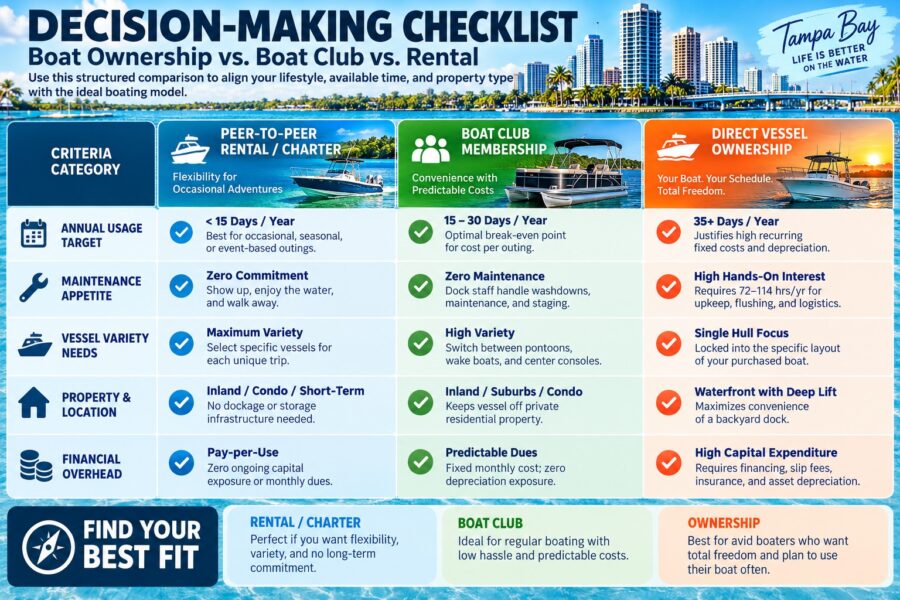
7. Decision-Making Checklist: Boat Ownership vs. Boat Club vs. Rental
Use this structured decision framework to align your lifestyle preferences, available time, and property type with the ideal boating model:
8. Conclusion: Balancing Freedom and Responsibility on Tampa Bay
Tampa Bay offers world-class access to shallow-water flats, coastal islands, urban riverfronts, and open Gulf waters. However, achieving true freedom on the water requires matching your financial investment to how you actually live and spend your time.
For boaters on the water fewer than 30 days a year, modern boat clubs, subscription models, and captained charters eliminate the maintenance burdens, time costs, and fixed overhead of slip rentals and depreciation. For active boaters who hit the water multiple times a week—or waterfront homeowners with a functional dock and lift—direct vessel ownership offers unmatched freedom, control, and convenience. Evaluate the numbers, assess your time budget, and choose the path that gets you onto Tampa Bay with maximum enjoyment and minimal friction.
