

 1. INTRODUCTION: THE HOA EXPLAINED
For many Floridians, the Homeowners Association (HOA) represents a persistent paradox. To some, it is a community savior—a shield that maintains property values and ensures the neighborhood remains aesthetic and orderly. To others, it feels like a bureaucratic hurdle, governed by volunteers with the power to dictate everything from the color of a front door to where a guest parks their car.
Is the HOA a “nanny state” or a vital protector of your home’s equity? The answer often lies in understanding the complex and frequently updated legal landscape of the Sunshine State. With recent landmark legislation like HB 1203 and refined statutory protections, the balance of power between boards and owners has shifted. This guide reveals the most impactful takeaways from Florida’s evolving laws that every homeowner and prospective buyer must understand to navigate community living effectively.
2. THE “NON-PROFIT” REALITY: WHERE YOUR MONEY ACTUALLY GOES
It is a common misconception that HOA fees represent profit for a developer or a management company. In reality, nearly all Florida HOAs are organized as non-profit corporations under the Florida Nonprofit Corporation Act (Chapter 617).
This legal structure means the association operates on an “at-cost” model. Every dollar collected through assessments is intended for the operation, maintenance, and management of the shared infrastructure. Fees are not designed to generate a surplus for stakeholders but to ensure the community remains a viable, functioning entity. This model is crucial for community stability; it ensures that the financial burden of maintaining common areas—such as roads, pools, and gates—is shared equitably among those who benefit from them.
“Board members have a fiduciary duty to act in the best interest of the entire community, not individual board members or favored members of the community.”
3. BEYOND THE BILL: OVERCOMING THE “HOA FEE” STICKER SHOCK
Many buyers view HOA dues as an “extra tax” or a financial burden that increases the risk of foreclosure. However, successful community living requires reframing these dues as “investment protection.” Consistent rule enforcement is what maintains a neighborhood’s desirability and prevents property values from stagnating.
To understand the value proposition of these fees, consider the specific protections and services they provide:
- Rental and Leasing Standards: Protects the community from becoming a transient hotel by enforcing minimum lease periods and tenant background checks.
- Safety and Fire Codes: Ensures common facilities and residential structures meet recognized standards (such as pool safety and fire codes) to protect community well-being.
- Architectural Guidelines: Ensures no neighbor installs a modification that depreciates surrounding homes through specific paint color, fencing, or roofing standards.
- Amenity Maintenance: Provides professional upkeep of pools, clubhouses, and fitness centers that would be far more expensive to maintain individually.
4. THE POWER OF THE PAPER TRAIL: WHY BUDGETS AND RESERVES ARE YOUR SAFETY NET
In Florida, transparency is not a courtesy; it is a statutory requirement. Under § 720.303, homeowners have a right to access “official records” within 10 business days of a written request. Crucially, the association must make these records available within 45 miles of the community or within the county where the association is located—a rule designed to prevent boards from stalling by claiming records are at a distant corporate office.
If a board ignores a records request, the law provides significant leverage. There is a “rebuttable presumption of willful noncompliance” if the deadline is missed, potentially entitling the owner to minimum damages of $50 per calendar day (up to $500). Be aware, however, that some boards attempt to use “confidentiality” as a magic invisibility cloak to hide non-privileged records. While items like attorney-client privileged communications are excluded, operational documents like contracts, bids, and ledgers are firmly within your right to inspect.
5. ESTABLISHING RESERVES: PREVENTING THE “SPECIAL ASSESSMENT” CRISIS
One of the most dangerous financial pitfalls for a Florida community is a “pay-as-you-go” mentality regarding major repairs. Proper establishment of reserves—funds set aside for the long-term replacement of roofs, paving, and painting—is the hallmark of a healthy HOA.
Failing to maintain adequate reserves often leads to a “Special Assessment crisis,” where homeowners are suddenly hit with a bill for thousands of dollars. Relying on special assessments burdens owners unexpectedly and damages the community’s reputation. Successful boards go beyond basic compliance, conducting regular audits and reserve studies to ensure the fund is prepared for the inevitable expiration of physical assets.
6. THE COMMUNITY CONTRACT: YOU OWN THE LAND, BUT YOU SHARE THE NEIGHBORHOOD
Living in a deed-restricted community means accepting a trade-off: you gain a standardized neighborhood in exchange for some personal autonomy. However, recent legislation has checked the power of the board. Under HB 1203, associations are now prohibited from banning personal vehicles (including pickup trucks) in driveways or fining owners for trash cans left out on collection day.
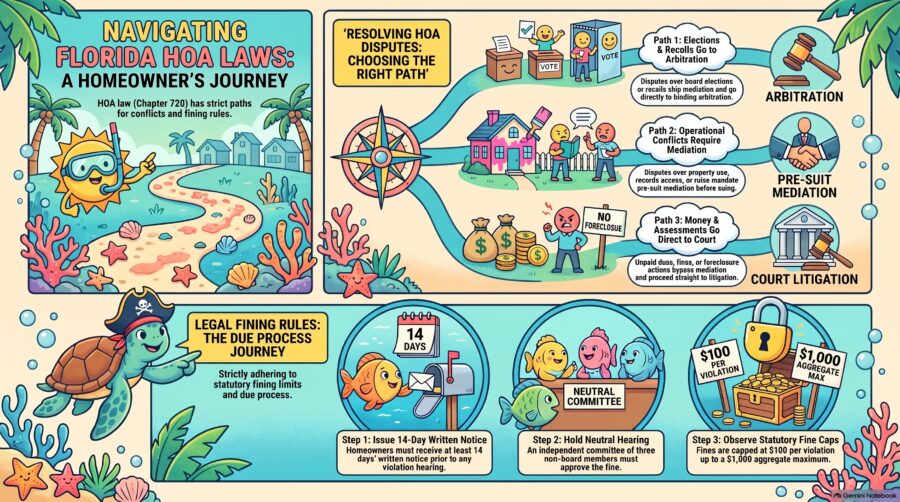
Furthermore, being a board member is no longer a role for the “uninformed volunteer.” As of 2024/2025, Board Member Education is a statutory mandate. Directors must meet annual hour requirements to ensure they understand the laws they are sworn to uphold. If your board is imposing fines, remember they must follow a strict process: 14 days’ written notice of a hearing, an independent 3-member committee (no board relatives), written findings within 7 days of the hearing, and a 30-day payment window if a fine is upheld.
7. THE “ULTIMATE LEVER”: UNDERSTANDING FORECLOSURE AND MEDIATION
The most surprising reality for many is that HOA liens can bypass Florida’s “Homestead Protection.” This is due to the “Relation-Back” theory: the association’s lien right relates back to the date the original community declaration was recorded—often years before you claimed homestead status. Effectively, you agreed to the lien as a condition of purchase.
The Foreclosure Timeline: Associations must follow a strict notice process before filing suit:
1. Notice of Late Assessment: 30 days to pay without attorney fees.
2. Intent to Lien: 45 days of warning via certified mail.
3. Intent to Foreclose: A final 45-day warning after the lien is recorded.
Warning: How Your Payment is Applied Under § 720.3085(3)(b), any payment you send is applied in a specific legal order: Interest first, then Late Fees, then Attorney Fees, and only lastly to the actual Assessment. If you owe fees and try to pay “just the assessment,” the assessment remains delinquent, which can trigger a foreclosure suit.
Mediation vs. Collection While Florida law mandates pre-suit mediation for rules disputes (which has a staggering 80% success rate), there is a major exception. Under § 720.311, the mandatory mediation requirement excludes the collection of any assessment or fine. While you can mediate a dispute over a fence color, money disputes can go straight to a collection lawsuit or foreclosure.
8. CONCLUSION: THE FUTURE OF THE SUNSHINE STATE COMMUNITIES
The legal environment in Florida is moving toward greater accountability. While high-impact reform bills like HB 657 (which would have allowed for the easier dissolution of HOAs) died in the Senate in March 2026, the overwhelming support for such measures in the House suggests the “HOA Reform” movement is just beginning.
As a homeowner, your greatest tool is the “Community Contract”—the governing documents. Whether you view your HOA as a “nanny state” or a “value protector” depends on your engagement. Take the time to read your documents and official records today; understanding the rules is the only way to ensure they are working for you, rather than against you.
