

 As a senior advisor with Future Home Realty, my role involves more than just navigating contracts; it is about ensuring the long-term health of both the property and the people living inside it. In the Tampa Bay area, our climate is a relentless adversary. According to the U.S. Energy Information Administration, heating and cooling account for 52% of average household energy costs. However, the true “cost” of staying cool is often hidden in health risks and structural degradation.
To understand the stakes, we must look at the data through an investigative lens. During recent extreme heat events, research found that a staggering 98% of heat-related deaths occurred indoors, with the majority being seniors over the age of 60. In our community—from the historic bungalows of Seminole Heights to the expansive new builds in Lakewood Ranch—managing the thermostat isn’t just a matter of “finding a sweet spot.” It is about reaching an optimal thermal equilibrium where efficiency, physiological safety, and moisture control meet.
The Summer Standard: Efficiency Meets Reality
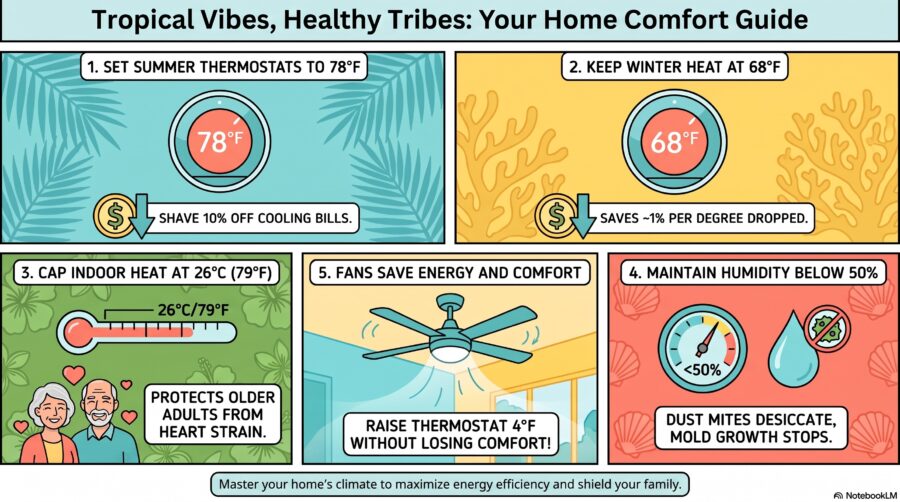
For most Tampa residents, the primary goal is surviving August without a utility bill that looks like a mortgage payment. The standard recommendation for energy efficiency is 78°F while you are home and while you sleep. While this may feel warm initially, it significantly reduces the mechanical strain on your HVAC system during peak humidity months.
To realize substantial savings—up to 10% on your cooling costs—I advise my clients to follow the “8 is Great” rule. If you are away for more than four hours, adjust your thermostat upward by 8 degrees (targeting a range of 85-88°F).
If 78°F feels like an impossible jump, use the “One Degree at a Time” method. Increase your setting by a single degree each day. This allows your body to acclimate naturally, often revealing that you are comfortable at a higher temperature than you previously assumed. However, as we will discuss, raising the temperature requires a vigilant eye on your home’s humidity.
Health-First Cooling: The 26°C (78.8°F) Threshold for Older Adults
We must distinguish between Thermal Comfort (subjective satisfaction) and Thermal Safety (physiological protection). For our neighbors aged 60 and over, Health guidance establishes 26°C (78.8°F) as the critical threshold for health.
When indoor temperatures exceed this limit, the body undergoes significant strain. Investigative studies have shown that sustained exposure to temperatures above this threshold causes “cellular stress,” “enterocyte damage” (disruption of the gastrointestinal lining), and “inflammatory responses” that can lead to cardiovascular events.
Indoor Temperature Ranges & Health Risk Levels (Seniors 60+)
| Indoor Temperature | Health Risk Level | Physiological Impact |
| ≤26°C (78.8°F) | Safe | Minimal change in core temperature; cardiovascular strain is negligible. |
| 26°C – 31°C | Escalating Risk | Cellular stress and enterocyte damage begin; increased heart strain. |
| >31°C | Critical Danger | Dramatically escalated risk of respiratory distress, dizziness, and death. |
For those with severe frailty or multiple health conditions, even 26°C may be too high. In these cases, active cooling is a non-negotiable medical necessity.
The Hidden Enemy: Moisture, Mold, and Relative Humidity
In Tampa Bay, the heat is often secondary to the moisture coming off the Gulf and Old Tampa Bay. Your air conditioner’s secondary job is as a dehumidifier. To prevent the growth of mold and dust mites, you must maintain Relative Humidity below 60%.
There is a dangerous synthesis here: if you raise your thermostat to 78°F for efficiency, your AC runs less frequently, which can cause humidity to spike above 70%. This is where the “Dry Mode” on modern units or a dedicated dehumidifier becomes essential.
Furthermore, beware the “Cold Spot” phenomenon. Blowing 70°F air against an exterior wall in a humid environment causes condensation. In older Seminole Heights homes or residences with impermeable vinyl wallpaper, this moisture becomes trapped against the gypsum board. This is a “hidden killer” of drywall, leading to toxic mold growth that remains invisible until the structural integrity is compromised.
The Homeowner’s Diagnostic Toolkit
- Hygrometer: Essential for ensuring humidity stays below 60% when you raise the temperature.
- Moisture Meter: Use this for quantitative assessments of wood and drywall near AC vents to detect hidden leaks or condensation.
- Infrared Thermometer: To identify “Cold Spots” on exterior walls that may be prone to mold.
Beyond Summer: Seasonal Shifts and Heat Pump Nuances
Tampa winters are brief, but they require a specific technical strategy. The efficiency standard is 68°F while home and 63-65°F while sleeping.
However, most Florida homes utilize heat pumps, which have a critical quirk. If you drop the temperature significantly while away (the “Setback” method), the system may struggle to recover and trigger backup electric heat strips. These strips consume massive amounts of electricity, often negating any savings you earned.
The Variable Speed Exception: If your home features a high-end, variable-speed heat pump, the “8 is Great” rule may not apply. These units are often most efficient when you “set it and forget it,” as they are designed to maintain a constant, steady temperature with minimal energy draws.
During the “Deadband” transitions of Spring and Fall, use the “Auto” mode. Set a 10-degree range (e.g., Heat at 68°F, Cool at 78°F) to ensure your system isn’t fighting itself during our unpredictable 40-degree temperature swings.
High-Tech Efficiency: Fans, Sensors, and Solar
- The Wind Chill Effect: Ceiling fans cool people, not rooms. Running a fan allows you to increase your thermostat by 3-4°F while maintaining the same comfort level. Ensure they spin counter-clockwise in summer and reverse them in winter to push trapped heat off the ceiling.
- Smart Sensors: Modern thermostats use geo-tracking and motion sensors to manage the “Away” settings automatically, ensuring the home is safe and efficient without manual intervention.
- Solar & SEER2: Investing in high-efficiency heat pumps (SEER2 rated) and solar power can fundamentally shift your financial profile, making the cost of maintaining a safe 78.8°F much more manageable.
Summary & Next Steps
A healthy Tampa Bay home rests on three pillars:
- Efficiency: 78°F for general occupancy and sleep to manage the 52% energy cost burden.
- Safety: A hard limit of 78.8°F (26°C) for seniors to prevent physiological cellular stress.
- Integrity: Maintaining <60% humidity via hygrometers and “Dry Mode” to prevent mold.
Checklist for Tampa Bay Homeowners
- [ ] Verify your hygrometer reading; is it consistently under 60%?
- [ ] Inspect walls with vinyl wallpaper for signs of “Cold Spot” moisture.
- [ ] Check if your heat pump is a variable-speed model before using large temperature setbacks.
- [ ] Confirm all ceiling fans are set to counter-clockwise for the summer season.
- [ ] Schedule a duct inspection to ensure positive air pressure, which helps keep humid air out of the building envelope.
Understanding the engineering of your home is the first step toward a secure investment and a healthy family. Whether you are looking for an energy-efficient new build or need advice on upgrading an older Tampa bungalow, I am here to provide the analytical expertise you deserve. Contact me at Future Home Realty today for a local perspective on the Tampa Bay market.
