

 The Hook: An Unlikely Recipe for Success
In the high-stakes world of 1980s casual dining, Tim Gannon was presented with a choice that would have paralyzed most: a million-dollar exit or the uncertainty of a dream. In 1987, Gannon arrived at Henderson Blvd in Tampa to co-found Outback Steakhouse with exactly $37 in his pocket. He was so cash-strapped he had been forced to sell his polo saddle just to afford the gas money for the drive. It was a humble, perhaps improbable, beginning for a man who would eventually scale a brand to over 1,100 locations across 27 countries.
Gannon’s journey was never linear. A graduate in Art History from Florence, Italy, he spent his youth immersed in the aesthetics of the Renaissance and the culinary rigors of Paris. This unconventional background instilled a “flavorist’s” curiosity—a deep-seated need to understand why a certain mayonnaise tastes better or how a simple onion can be transformed into architecture. In a recent episode of The Instant Payments Podcast, Gannon distilled the philosophical shifts that turned a “wild west” Australian theme into a global empire.
The Power of “No”: Why He Ripped Up a $1 Million Check
Early in his career, while working for Popeyes founder Al Copeland, Gannon faced a defining moment of narrative tension. Recognizing Gannon’s talent, Copeland offered him a $1 million check to stay on as a salaried employee. At the time, Gannon was drowning in $250,000 of debt at a staggering 18% interest rate, with two children and no home of his own. The check represented instant salvation; the dream represented only more debt.
Gannon shredded the check. He realized that a salary, no matter how substantial, is ultimately a ceiling, whereas equity is a floor upon which one can build a legacy. His decision to drive to Tampa was a bet on the “Unit Economics of Partnership”—the belief that working with someone as an owner is infinitely more valuable than working for someone as a line item.
“I ripped the check up. And I drove to Tampa and started Outback… I didn’t want to take your check and owing you the rest of my life. I want to make money with somebody.”
The “Flavorist” Moat: Turning 40% Waste into a Billion-Dollar Asset
Gannon describes himself as a “flavorist,” a niche he spent a decade cultivating in New Orleans. He observed how Cajun chefs took “poor man’s food”—low-cost commodities like rice and onions—and elevated them into gourmet experiences. This obsession led to the creation of the Bloomin’ Onion, a product that has now surpassed $1 billion in total sales.
The strategy behind the onion was a masterclass in operational moats. Gannon collaborated with Dr. Leonard Pike at Texas A&M to source specific seeds that could grow four-and-a-half-inch onions with a single heart. Before finding this solution, the brand was throwing out 40% of its onions because they couldn’t meet the rigorous “Chrysanthemum” cut.
While competitors like Chili’s attempted to copy the recipe, they couldn’t copy the kitchen. Gannon knew his “moat” wasn’t a patent; it was fryer capacity. His rivals’ P&Ls couldn’t justify the massive kitchen infrastructure required to push out that volume of onions during a rush. It is a vital lesson for the modern strategist: Intellectual Property is often less defensive than operational complexity.
The 3-Table Rule: The Unit Economics of the Human Element
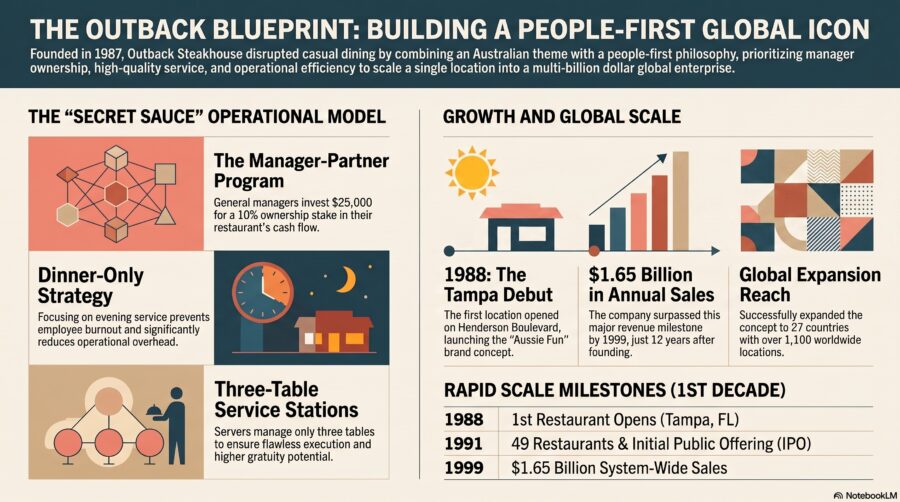
In an industry obsessed with maximizing tables per server to suppress labor costs, Outback took a radically counter-intuitive path: the “three-table station.” By strictly limiting servers to just three tables, Gannon and his partners (Chris Sullivan and Bob Basham) ensured that the guest experience was one of concentrated, flawless service rather than a frantic scramble.
This move proved that in hospitality, less is often more. This “Unit Economics of the Human Element” meant that hot food stayed hot and cold food stayed cold, delivered with the poise of a fine-dining establishment. Because the restaurants were consistently packed, the servers actually earned significantly more in tips than they would have at a high-volume, low-touch competitor. By decreasing the volume per server, they increased the quality per transaction, driving the repeat business that defined the brand’s early success at the original Henderson Blvd location.
The $25,000 “Skin in the Game”: Building a Company of Owners
Outback’s most potent cultural engine was the “Manager Partner Program.” To become a proprietor, a manager had to write a personal check for $25,000. In exchange, they received 10% of the unit’s cash flow. This wasn’t just an incentive; it was the “High Cost of Entry to Greatness.” Asking an employee to invest their own savings created a profound psychological shift, lighting an entrepreneurial flame that no base salary could ever kindle.
As the brand scaled, the founders realized they were running out of people they knew from their Steak and Ale days. To prevent the culture from diluting, they authored a six-page “Principles and Beliefs” manuscript. This doctrine mandated that every decision be balanced between the needs of employees, guests, and investors. This shared equity model resulted in proprietors earning an average of $200,000 a year, proving that spreading the wealth is the most effective way to protect it.
Technology as a Tool for Respect: The Future of the Frontline
Gannon, a man who competed as a Polo champion well into his later years, understands that excellence requires the right tools. He views modern technology—such as digital ordering and Instant payments—not as a replacement for the human touch, but as a way to show respect to the worker.
He draws a parallel to the Chick-fil-A model of hiring “the whole choir” and providing scholarship programs. By using technology to facilitate earned wage access and remove the friction of paper tickets, a business allows the server to focus on the guest. Enormous unit volume is a direct byproduct of how a company treats its hourly workforce. When the “stumble” of financial stress is removed through instant access to tips and wages, loyalty and performance follow.
Conclusion: The “Nap-Free” Path Forward
Today, Tim Gannon is mentoring his son, Chris, through the growth of Bolay Fresh Bowl Kitchen. He watched his son “stumble” through the challenges of CEO-ship and helped him find his footing—much like he once found his own in Tampa. The focus remains on “clean” food that avoids the “gotta take a nap” feeling, emphasizing that the modern consumer wants to leave a meal feeling energized, not depleted.
His journey from a penniless arrival in Tampa to a global icon serves as a permanent reminder that culture is the ultimate competitive advantage. Whether it is through a $25,000 buy-in or a three-table station, Gannon’s career proves that financial results are merely the shadow cast by the people you empower.
The final question for any modern entrepreneur is this:
Is your business culture designed to merely “manage the labor,” or is it built to “spread the wealth” and create a company of owners?
