

1. Introduction: The Sun, the Sand, and the Secret Menu
When travelers descend upon Florida’s Gulf Coast, the gravitational pull of white-sand beaches and neon-lit tourist traps is nearly impossible to resist. But for those who venture past the generic “Fuddy McHoolihan’s” outposts, a far richer landscape awaits. In the “Sunshine City” of St. Petersburg and the historic brick-paved corridors of Tampa, the culinary scene isn’t shaped by corporate focus groups, but by a century of cultural collision.
By the 1920s, local newspapers were already boasting of the region’s “three great delights: sunshine, cigars, and soup.” This was a peninsula defined by a unique blend of Spanish, Cuban, Italian, and Greek immigrant history—a melting pot where traditions didn’t just coexist; they fused into something entirely new. Today, the region’s most iconic dishes offer more than just flavor; they serve as a living map of resilience, with histories more surprising than a first bite might suggest.
2. The “Cubano” Controversy: It’s All About the Salami
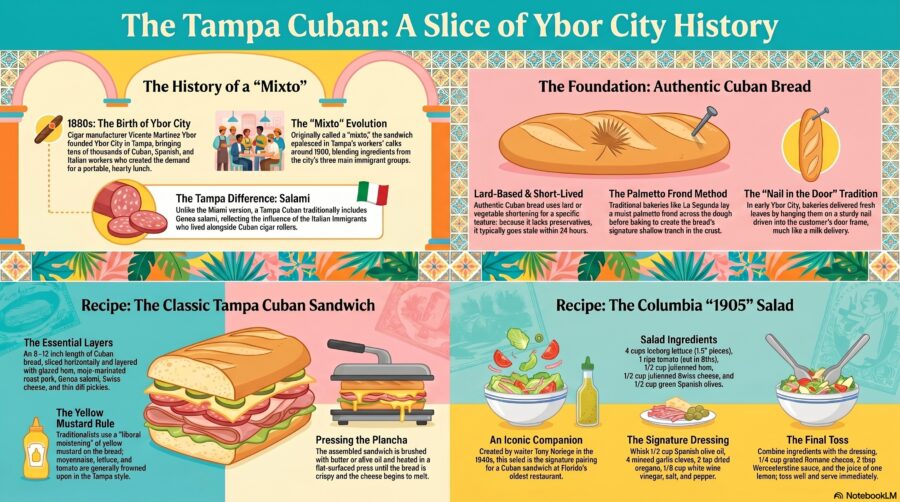
While Miami and Havana often bicker over the lineage of the Cuban sandwich, the “Cubano” as we know it today is a quintessentially Tampa-born creation. Emerging in the mid-1880s to fuel tens of thousands of cigar rollers in Ybor City, the sandwich was a mobile feast designed for the working class. However, the Tampa version carries a specific, counter-intuitive ingredient that serves as a culinary fingerprint of the neighborhood’s history: Genoa salami.
In the early 20th century, Ybor City was a rare enclave where Italians, Cubans, and Spaniards lived and worked in intimate harmony. The addition of salami was the Italian contribution to the Spanish ham and Cuban roasted pork, creating a “mixto” that reflected the literal makeup of the community. This distinction is so fiercely protected that it has been codified by law:
“The ‘Historic Tampa Cuban Sandwich’ was designated the ‘signature sandwich of the city of Tampa’ by the Tampa City Council in 2012.”
3. The Bread That Breathes Through a Palm Leaf
A true Cuban sandwich is only as legitimate as the bread it’s built upon. Authentic Cuban bread is a technical marvel of old-world baking, characterized by a pillowy, aerated heart shielded by a crust as fragile and sharp as blown glass. Traditional bakeries like La Segunda, which has been firing its ovens since 1915, still use a labor-intensive method that sets it apart from any commercial imitator.
The most fascinating detail of this process is the use of the palmetto frond. Before the loaves enter the oven, a long, moist palm leaf is laid across the top of the dough. This creates a signature shallow trench as the bread rises and bakes, serving as a natural, Florida-grown scoring tool.
The Three Essential Traits of Authentic Cuban Bread:
- Length: Traditional loaves are approximately three feet long and rectangular in cross-section.
- Ingredients: The recipe must include lard, which provides the specific texture and richness that vegetable shortening simply cannot replicate.
- The Palmetto Scoring: Each loaf is scored by a palmetto frond, a tradition that allows the bread to “breathe” and create its distinctive crust pattern.
4. From Bait Fish to Billion-Dollar Brand: The Grouper Story
The grouper sandwich is now a high-end staple of Florida’s beachfront culture, but its origins were decidedly less glamorous. In the early 1900s, fishermen at Port Tampa viewed grouper as a “bait fish,” useful only for catching more desirable species like redfish. It wasn’t until the post-WWII explosion of Florida beach culture that fishing families began promoting the mild, flaky fish—fried and served on a bun with tartar sauce—as a premier table fare.
This shift in status led to a bizarre historical irony. In 1969, the Florida Department of Agriculture developed a specific test to ensure restaurants weren’t substituting the then-cheap grouper for the more expensive snapper. By the early 2000s, the tables had turned completely. Grouper had become so valuable—a billion-dollar brand—that a “Great Grouper Scandal” erupted. Demand had pressured goliath grouper toward extinction, leading unscrupulous restaurants to substitute cheaper tilefish or tilapia for the premium “guaranteed grouper” their customers craved.
5. The Strike-Born Snack: The Deviled Crab’s Revolutionary Roots
The Tampa-style deviled crab (croqueta de jaiba) is a masterclass in culinary resourcefulness born of necessity. During the bitter cigar factory strikes of the late 1920s, home chefs in Ybor City needed a way to feed families on a pittance. They looked to the waters of Tampa Bay, which were teeming with blue crabs, and paired the meat with the one thing every immigrant household had in abundance: stale Cuban bread.
By using the hardened remains of the loaves mentioned earlier, these “protest foods” transitioned from a survival snack into a beloved street food sold from bicycles and pushcarts. The result is a football-shaped croquette, densely packed to be eaten with one hand while on the move.
The traditional preparation involves slowly sautéing the crab meat in a “chilau” sauce—a version of a Cuban-style sofrito made with tomatoes, onions, and peppers—before rolling the mixture in breadcrumbs and deep-frying it to a perfect, savory brown.
6. The Greek Diving Revolution in Tarpon Springs
Just north of St. Petersburg lies Tarpon Springs, a town that underwent a maritime revolution in 1905. Before this time, Floridians “hooked” sponges from the surface using long poles. John Cocoris, a Greek sponge buyer, knew there was a better way. He brought 500 Greek immigrants to the Gulf, introducing high-tech diving suits of canvas and rubber topped with heavy brass helmets.
This maritime influx didn’t just revolutionize the industry—harvesting four times the sponges of the old methods—it solidified the region’s specialized foodie status. The Greek wave brought with it flavors of the Mediterranean that remain synonymous with the area today. The tradition is still whispered through the ages by artisans like Nicholas Toth, the region’s last living diving helmet maker, who keeps the brass-and-glass legacy alive.
7. The Salad That Answered the Buffet Craze
No visit to the Gulf Coast is complete without a stop at the Columbia Restaurant, Florida’s oldest dining institution. While their menu is a library of Spanish-Cuban history, their “1905” Salad remains their most famous export. Originally created by waiter Tony Noriega in the 1940s, the salad became an iconic national phenomenon in the 1970s as a sophisticated, high-quality answer to the lackluster salad bar craze that dominated American dining at the time.
While the ham, Swiss cheese, and Spanish olives provide the bulk, the secret to the salad’s zing is the signature dressing. For those attempting to recreate the magic at home, the Columbia offers an insider tip: for the best results, the dressing should be prepared 1 to 2 days in advance to allow the garlic and oregano to fully infuse the oil.
The “1905” Dressing Ingredients:
- Extra-virgin Spanish olive oil
- Minced garlic cloves
- Dried oregano
- White wine vinegar
- Worcestershire sauce
- Lemon juice
- Romano cheese
8. The Anti-Cocktail Sauce Philosophy
While the region honors its history, it also sits at the vanguard of the modern “purity” movement in seafood. At the “Empire Oyster” pop-up in St. Pete, you will find an uncompromising refusal to serve cocktail sauce with their bivalves. This isn’t mere elitism; it’s a philosophy rooted in 19th-century history. In an era before modern refrigeration, the pungent mix of horseradish and ketchup was a necessity to mask the scent of oysters that were no longer fresh.
In a modern raw bar, where oysters are harvested from pristine waters and served immediately, such a mask is considered a culinary crime. Instead, chefs highlight the natural salinity and “briny pop” of the oyster with sophisticated alternatives like mezcal pearls, allowing the purity of the seafood to take center stage.
“It [cocktail sauce] was developed in 19th Century NYC to mask the scent and taste of a rancid oyster, and there simply is no place for it on a fresh, ultra-premium oyster from pristine waters.”
9. Conclusion: A Taste of History
To eat your way through St. Petersburg and Tampa is to consume a century of cultural resilience and ingenuity. From the resourceful use of stale bread during the cigar strikes to the “salami scandal” that defines a local sandwich, every bite is a testament to the immigrant groups who took the bounty of the Gulf and turned it into an enduring legacy.
The next time you find yourself on the Gulf Coast, staring down a menu at a sun-drenched table, ask yourself: Will you ask for the story behind the bread, or just the check?
