

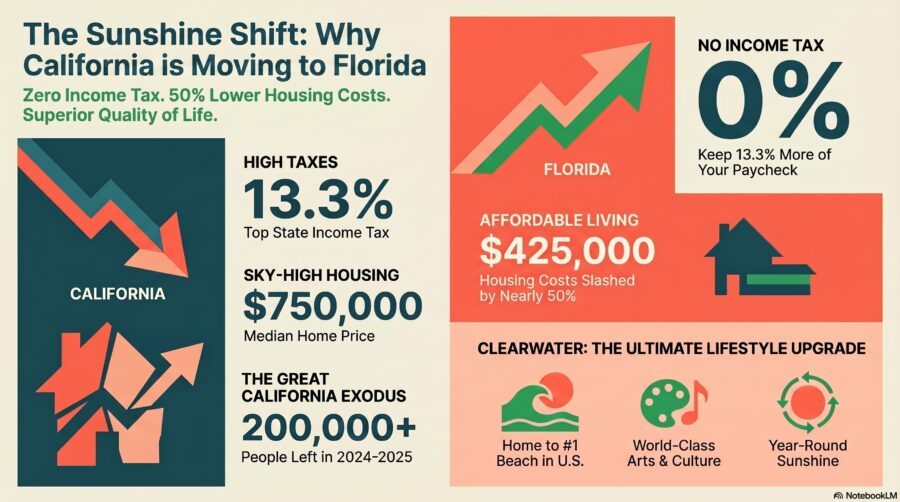
 For years, a singular narrative has dominated the American cultural and economic conversation: the “California Exodus.” The story is familiar—oppressive taxes, skyrocketing housing costs, and a regulatory “doom loop” are supposedly driving residents in droves toward the business-friendly, sun-drenched promise of Florida. It is a compelling tale of two states, framed as a binary choice between a fading Golden State and a rising Sunshine State.
However, to understand this great internal resorting, we must look past the anecdotes and into the administrative records that reveal a more complex architecture of American migration. Is California actually emptying out, or are we witnessing a structural transformation of the American middle class? By distilling dense tax records, regulatory counts, and demographic data, we can move past the political noise to reveal a nuanced truth that challenges the standard binary.
1. Takeaway 1: The Talent Revolving Door
The term “exodus” implies a one-way flight, but the data suggests something closer to demographic “churn.” According to Rachel Massaro, director of research at the Silicon Valley Institute for Regional Studies, the region is defined more by motion than by departure.
While the 2025 Silicon Valley Poll indicates that 43% of residents are considering leaving, the total population remained remarkably stable, even ticking up by a fraction of a percent in 2024. This stability is maintained by a constant influx of international talent; currently, 66% of tech workers in the region were born outside the United States.
What we are witnessing is a profound demographic turnover. The group leaving California largely consists of families and long-time residents who feel priced out of the future. The group arriving is typically younger, highly educated, and internationally mobile.
“While many residents say they plan to move, others continue to arrive, keeping the region in constant motion.” — Rachel Massaro
This turnover brings both renewal and instability. From an economic perspective, the talent pipeline is constantly refreshed, but from a societal one, we must ask: Is a city still a community if it is merely a revolving door for global elites? When the middle class is hollowed out, the social fabric that sustains schools, local civic life, and multi-generational neighborhoods begins to fray, leaving behind a transient population of high-earners with fewer roots in the soil.
2. Takeaway 2: The Millionaire Tax Flight is Largely a Myth
A common argument for California’s decline is that the wealthy are fleeing high state taxes. However, a 25-year study by the Stanford Center on Poverty and Inequality found that for the vast majority of high-earners, “tax flight” is an irrational move.
The researchers discovered that millionaire income is inherently “spiky.” A representative millionaire is only in the top tax bracket for about half of their prime earning years. Furthermore, only 14% of their total 13-year “lifetime” income actually falls into that top marginal bracket. Most individuals who reach this level do so during a temporary windfall—a singular “good year”—making it logistically and strategically difficult to move specifically for tax purposes.
In a striking comparison, the data shows that personal life events are far more predictive of migration than tax policy:
- Divorce: A recent divorce more than doubles the out-migration rate of high-income earners.
- Tax Increases: A one-percentage-point tax increase has a migration impact of only 0.04%.
Wealthy residents remain in California primarily due to “agglomeration economies.” For high-level professionals, wealth is dependent on being in the room where the venture capitalists and engineers are. If your professional network and access to capital—which generates the remaining 86% of your lifetime wealth—is rooted in Silicon Valley, a 13.3% tax is a small price to pay for the access that makes those millions possible in the first place.
3. Takeaway 3: The “Sunshine Tax” has Become a “Sunshine Tariff”
While the wealthy may stay for the networks, the middle class faces a different reality. What was once considered a manageable “lifestyle tax”—a small premium for California’s climate—has evolved into a “Sunshine Tariff” that is increasingly inescapable for the working professional.
Regulatory burdens are now significant outliers. California’s policy text contains 3,737 mandatory regulatory constraints (using restrictive language like “shall,” “must,” and “prohibited”). This accumulative burden hits small and mid-sized business owners hardest, as they lack the compliance teams and legal retainers of larger firms.
The “math” for the average resident is becoming oppressive:
- Income Tax: California’s top effective wage tax (including the 1.1% payroll tax with no ceiling) reaches 14.4%, compared to Florida’s 0%.
- Utilities: In places like Bakersfield, utility costs are a staggering 73% higher than the national average—an unavoidable cost for families surviving the valley heat.
- The Billionaire Catalyst: A proposed 2026 ballot measure for a 5% worldwide wealth tax on individuals worth over $1 billion is already driving high-net-worth individuals out “in droves,” according to tax specialists.
For the wealthy, taxes are a “high-class problem.” For the middle class, the “Sunshine Tariff” is a wall of utility bills, regulatory hurdles, and $1.9 million median home prices that effectively bar entry to the California dream.
4. Takeaway 4: The Florida Education Paradox
One of the most counter-intuitive findings is that Florida is effectively “schooling” California in public education. Data from the Pacific Research Institute suggests that demography is not destiny when it comes to student outcomes.
The comparison reveals a stark gap:
- The Funding Gap: California spends over $2,300 more per pupil than Florida.
- The Outcome Gap: Low-income Florida 4th graders outperform all California 4th graders in reading.
The intellectual heart of this source is the performance of Florida’s Hispanic students. On a test conducted in English, Florida’s Hispanic 4th graders outscore the overall averages of 15 other states, including California. While California has higher median incomes and more degreed adults, Florida’s shift toward a model of “top-down accountability and bottom-up parental choice” has allowed it to surpass the Golden State in the very metric—literacy—that serves as a bellwether for future economic stability.
5. Takeaway 5: The “Hidden” Costs of the Florida Dream
For those who do make the leap to the Sunshine State, the transition is rarely a fiscal paradise. Many trade earthquake anxiety for hurricane prep and high state taxes for “private taxes” that can be just as burdensome.
The reality of the “Florida Dream” includes significant, soul-crushing stressors:
- The Insurance Crisis: Property insurance premiums in coastal areas are reaching $4,000 to $6,000 annually. This essentially functions as a private tax, required to mitigate the 1-in-49 chance of becoming a victim of crime or the constant threat of hurricane damage.
- Tourist Congestion: With over 4 million visitors annually, local life is often hijacked by visitors. Residents find specific corridors like Memorial Causeway and Gulf View Boulevard backed up for miles, leading locals to avoid their own beaches entirely on weekends to dodge the chaos.
- The Crime Metric: Data from NeighborhoodScout indicates that Clearwater has a “Total Crime Index” of 16, meaning 84% of U.S. cities are safer.
There is a profound irony in moving to escape the “stress” of California, only to find oneself trapped in 100-degree humidity, navigating tourist-clogged causeways, and paying insurance premiums that rival a California tax bill.
Conclusion: A Great Internal Resorting
The data suggests that California is not dying; rather, it is being rebranded as a “luxury good” for a global elite that can afford the entrance fee. It remains a magnet for international ambition and high-tier innovation, even as it becomes functionally unlivable for the domestic middle class. Florida, conversely, is not just a tax haven; it is a complex landscape where the absence of a state income tax is balanced against soaring insurance costs, environmental risks, and infrastructure strain.
This leads us to a final, necessary question: How should we measure a state’s competitiveness? Is it by its ability to attract billionaires with low tax rates, or by its ability to provide the middle class with a viable path to homeownership and high-quality education?
As we move forward, it is clear that “Place Still Matters.” However, the price of that place is being recalculated in every U-Haul crossing the state line, signaling a country that is no longer just moving, but fundamentally resorting itself along the lines of wealth and risk.
