

 Beyond the Beach
When travelers look toward Florida’s west coast, they usually see the postcard-perfect white sands of St. Petersburg or the shimmering skyline of Tampa rising over the water. But for those of us who study the table, the real magic happens on the narrow peninsula between Tampa Bay and the Gulf of Mexico. This is a landscape where the salt air of the Gulf drifts inland to meet the heavy, intoxicating scent of roasting coffee and hand-rolled tobacco in Ybor City.
For over a century, this region has been defined by a “triple threat” of delights: Sunshine, Cigars, and Soup. It is a place where historic food traditions, forged in the heat of immigrant kitchens and labor warfare, now provide a foundation for edgy young chefs. To eat here is to consume a record of resilience. Beyond the tourist traps lies a story of migration and local ingenuity that turned humble bait into luxury and rationed bread into a symbol of pride.
The “Cubano” Wasn’t Actually Born in Cuba
It is perhaps the most famous sandwich on the planet, but the “Cubano” is a Florida original. While its name pays homage to the island, the sandwich as we know it today did not originate in Havana; it “coalesced” in the mid-1880s within the cigar-rolling capital of Ybor City.
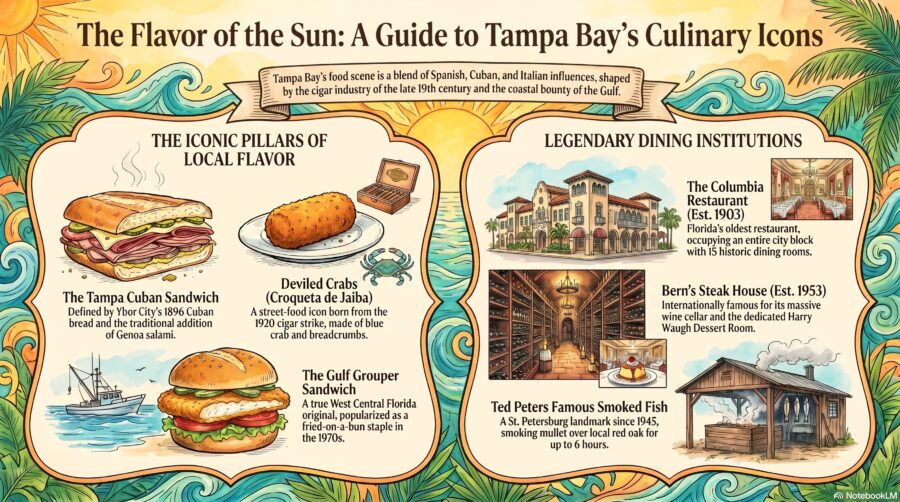
As tens of thousands of workers moved between Key West, Tampa, and Havana, they carried with them the “mixto”—a portable, flexible lunch for factory workers. In the immigrant cafes of Tampa, the mixto evolved into the distinct Cuban sandwich. The inclusion of Genoa salami—a point of fierce, ongoing rivalry between Tampa and Miami—is a culinary stamp left by the Italian immigrants who lived and worked alongside Cuban and Spanish laborers. This sandwich was never just a meal; it was a record of cultural blending.
As noted in Cigar City Magazine:
“The elongated loaves of Cuban bread betray a history of hunger and rationing… The Cuban sandwich turned those thin loaves into symbols of plenty.”
Deviled Crabs: A Delicious Relic of Labor Warfare
The deviled crab (croqueta de jaiba) is the quintessential Tampa snack, but its birth was a product of “quiet desperation” during the traumatic 1920 cigar worker strike. When manufacturers attempted to “starve” the union into submission during a brutal ten-month work stoppage, families turned to the bay to survive.
Blue crabs were plentiful and, crucially, free to anyone with a string and a piece of bait. Striker families caught the crabs, seasoned the meat with a spicy chilau (sofrito) sauce, and used breadcrumbs from stale Cuban bread to make the expensive meat go further. These dense, oblong rolls were deep-fried and sold from pushcarts, allowing workers to earn rent money while providing a portable, hand-held meal for those on the picket lines.
B.B. Menendez of the Tropicana Restaurant remembered the era as a struggle for survival:
“During the long, lengthy cigar strikes, there were no other means of income, so the cigar makers used to go fishing for crabs. They boiled them and made crab rolls to sell on the street corners.”
The Quirky Tradition of the “Coke with an Olive” Long before Bayshore Boulevard was lined with luxury high-rises, the historic Colonnade Restaurant was a mid-century drive-in where the air was filled with the sound of “curb girls” taking orders and the neon glow of cruising teenagers. The restaurant’s quirky house specialty—a hand-mixed Coca-Cola garnished with a salty green olive—became a kitschy hallmark of Tampa’s laid-back culture. This whimsical combination of sweet and salt helped the Colonnade achieve exceptionally high soda sales and remained a nostalgic staple long after the restaurant transitioned into a white-tablecloth seafood icon.
Breakfast Was Delivered Like Milk (on a Nail)
In the early 1900s, the morning air in Ybor City carried the rhythmic thud-thud of hammers. Residents would drive a sturdy nail halfway into their door frames, creating a communal delivery system for the La Joven Francesca bakery. For just three to five cents, a deliveryman would hang a fresh, three-foot loaf of Cuban bread on the porch, much like a bottle of milk. The smell of that warm, fresh dough was the alarm clock for an entire community.
The “real” Cuban bread of Ybor City is a biological marvel that requires specific traditional techniques still honored by icons like La Segunda:
- The Massive Scale: Each loaf is approximately three feet long.
- The Contrast: It features a hard, thin, almost papery toasted crust that shatters when bitten, protecting a soft, flaky center.
- The Palmetto Frond: A moist palmetto frond is laid across the dough before baking. This isn’t for flavor; it creates the signature shallow trench—the “split”—that allows the bread to expand without bursting.
The 79,000-Square-Foot “Roman Holiday” in the Tropics
While the early 20th century was defined by the humble “bread on a nail,” the 1950s ushered in Florida’s “palace of grandeur” era. The pinnacle of this shift was the Kapok Tree Inn in Clearwater. Built around a massive, century-old Kapok tree planted in the late 1800s, this 79,000-square-foot architectural marvel was designed as an intentional escape from “everyday humdrum life.”
The scale was staggering. Billed as a “Roman Holiday” transplanted to the tropics, the Inn featured 12 distinct dining rooms filled with opulent Roman-inspired columns, intricate plasterwork, and grand ballrooms. It was a dining factory of the highest order, once serving a record-shattering 17,000 people in a single day. For decades, it stood as a testament to the mid-century American desire for theatrical, larger-than-life dining experiences.
Grouper: The “Bait Fish” That Became a Luxury
Today, the grouper sandwich is a “market rate” luxury, but in the early 1900s, it was barely considered food. Fishermen at Port Tampa actually used small grouper as bait for redfish. It wasn’t until the late 1960s that prominent fishing families began promoting fried grouper on a bun as a way to move what was then an underappreciated catch.
By the 1990s, however, the popularity of the fish—especially the massive Goliath Grouper—put immense pressure on local populations. The state’s ban on harvesting Goliath Grouper in the 1990s created a supply vacuum that led to the “grouper sandwich scandal” of the early 2000s. DNA testing revealed that many restaurants were substituting cheaper tilefish or tilapia for the “real thing.” This fraud only served to cement the status of authentic Gulf grouper as a high-end regional delicacy that diners were willing to pay a premium to protect.
A Taste of the Tampa Bay Legacy
From the smoky richness of mullet cooked over red oak at Ted Peters to the crisp bite of the “1905” salad—a Columbia Restaurant classic created by waiter Tony Noriega as an answer to the ubiquitous salad bar—the flavors of this region form a dual-city identity.
St. Petersburg, the “Sunshine City,” and Tampa, the “Cigar City,” have spent over a century trading recipes and rivalries. These dishes are not just artifacts; they are the living remnants of labor strikes, immigrant dreams, and the transition from bait-fish to fine dining.
As you sit on the bay with a sandwich in hand, ask yourself: does the bread taste better knowing it was once delivered on a nail? Does the crab taste richer knowing it was the only thing keeping a striker’s family fed in 1920? In Tampa Bay, history isn’t tucked away in a museum—it’s right there on your plate.
