

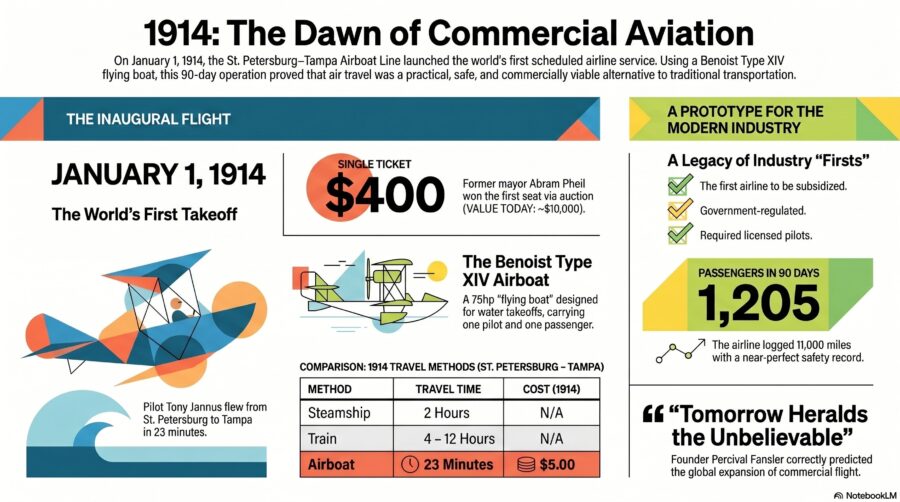
 In 1913, the world was a dauntingly large place. To travel just 20 miles across Tampa Bay between St. Petersburg and Tampa, a traveler faced a grueling day-long odyssey: two hours by steamer, up to twelve hours by train, or twenty hours in an automobile over “unthinkable” roads. It was a landscape defined by geographic isolation, where the pace of life was dictated by the limitations of steam and horse.
Yet, on New Year’s Day in 1914, a small band of visionaries launched the St. Petersburg-Tampa Airboat Line. This was not merely a local curiosity; it was the birth of the global system of regulations and norms that governs every flight you take today. As an aviation historian, I see this moment as the “Big Bang” of our industry—the point where the audacity of the early aviators met the hard reality of government licensing, creating the DNA of the modern ICAO framework.
The $400 Ticket for a Five-Foot Flight
The world’s first scheduled commercial flight on January 1, 1914, was a high-stakes public spectacle. To secure the first-ever seat, former St. Petersburg Mayor Abram C. Pheil entered a fierce bidding war. He ultimately paid a staggering $400—roughly $12,000 in today’s currency—to sit in the open wooden cockpit of a Benoist XIV airboat next to pilot Tony Jannus. Pheil outbid a local rival, Noel Mitchell, who stopped at $375 and eventually took the second flight for a more modest $175.
As the Italian Band of the Johnny Jones Carnival played “Dixie” to a crowd of 3,000, the “Lark of Duluth” taxied out of the harbor. During the 23-minute crossing, the craft rarely exceeded an altitude of five feet above the waves. This was the ultimate paradigm shift: moving aviation away from “jazz trips” and daredevil exhibitions toward a “real commercial line.”
“Some day people will cross the oceans in airships like they do in steamships today.” — Thomas Benoist
The “Lost in the Mail” Start of an Industry
The dawn of commercial aviation was nearly aborted by a series of chaotic logistical hurdles that would have broken lesser men. P.E. Fansler, a salesman who had previously sold a Buffalo road roller to Pinellas County, and Thomas Benoist faced a comedy of errors. Their primary aircraft—a green and yellow airboat dubbed the “Lark of Duluth,” owned by Julius Barnes—went missing in the railroad system for days. It only appeared on December 30, less than 48 hours before the scheduled launch.
Simultaneously, the construction of the airline’s hangar was paralyzed by labor disputes. Local carpenters, incensed by the use of non-local workers, threatened a labor action that forced the airline to operate in the open air for nearly a month. Yet, the most significant hurdle was a Tampa port inspector who accosted Jannus for lacking fog horns and life preservers. This “harassment” led to the first federal ruling that an airboat is a “motor boat,” establishing the precedent for government regulation and licensing that serves as the foundation for the FAA today.
The 1944 Chicago “Bargain”: Designing Peace During War
While the 1914 flight was a local miracle, the global network we use today was forged in a high-altitude chess match. In 1944, delegates from 54 nations met for the Chicago Convention to architect the future of civil aviation. It was the “Bretton Woods of the sky,” conducted while World War II still raged. The geopolitical tension was palpable: the Soviet delegation traveled as far as Montreal before turning around and fleeing home, repulsed by the presence of neutral “fascist” associates like Spain and Portugal.
The convention was a clash of empires:
- The British “White Paper”: Sought a powerful international body to limit competition and protect national interests.
- The United States’ “Summary of Objectives”: Led by Assistant Secretary of State Adolf Berle, the U.S. advocated for open competition and “freedom of the air.”
The “Fifth Freedom” became the ultimate bargaining chip. In a move of raw geopolitical maneuvering, President Roosevelt sent a telegram to Winston Churchill, essentially threatening the future of British Lend-Lease aid if the UK did not concede to a more open air agreement.
“The approaching defeat of Germany… sets up the urgent need for establishing an international civil air service pattern… so that the restorative processes of prompt communication may be available to assist in returning great areas to processes of peace.” — President Franklin D. Roosevelt (read by Adolf Berle)
The Invisible “Freedoms” That Power Your Vacation
Modern international travel relies on a set of “invisible rules” established during those 1944 negotiations. These “Freedoms of the Air” are the legal reason you can book a single ticket across three continents.
- Overflight: The right to fly over a country without landing.
- Technical Stop: The right to land for fuel or repairs.
- Exporting Passengers: Carrying passengers from the home state to a foreign state.
- Importing Passengers: Bringing passengers back to the home state.
- Intermediate Stops: Picking up or dropping off passengers in a foreign state while en route to a third country.
Without the Fifth Freedom, a carrier like Emirates could not pick up passengers in Milan on a flight from Dubai to New York. These rules transformed a fragmented map into a cohesive global system, replacing colonial-era trade monopolies with a standard multilateral agreement.
The “Innocent Passage” vs. Air Sovereignty
A fundamental struggle defines our skies: Who owns the air? The 1919 Paris Convention had declared “complete and exclusive sovereignty,” effectively creating “blocs of closed air.” This was a recipe for conflict. The 1944 Chicago Convention countered this with the “Chicago Bargain,” introducing the concept of innocent passage.
This allowed for a delicate balance of power. While nations maintained sovereignty over the air above their soil, they agreed to non-discriminatory access for civil aircraft. This compromise prevented the sky from becoming a battlefield for “colonial-era sea rights,” ensuring that no single alliance could choke off global commerce. It allowed for the seamless coordination of air traffic control that makes modern flight the safest mode of transport in history.
Toward the Next 100 Years
Aviation has evolved from a single 23-minute flight across a bay to a global system that celebrated its 10-billionth passenger in 1995. At that celebration, the grandchildren of Abram Pheil—Betsy, Peter, and Bill—met with House Speaker Newt Gingrich, connecting the “audacity” of 1914 to the modern political recognition of aviation as a global force for good.
As we transition from traditional winged aircraft to new technologies and shifting alliances, we must ask: Will the “Chicago Bargain” of 1944 continue to hold? Our current system of friendship and understanding depends on the same diplomatic grit that turned a five-foot-high flight across Tampa Bay into the most successful international regulatory framework in human history.
