

 Choosing a listing price is perhaps the most gut-wrenching decision in the entire home-selling process. For most homeowners, it feels like an impossible gamble. You want to “shoot for the moon” to capture every cent of equity, yet the fear of “leaving money on the table” by pricing too low keeps you up at night.
But here is the counter-intuitive truth that top-tier consultants know: success in real estate is rarely about the objective math of a spreadsheet. It is about the subjective psychology of the buyer. Your asking price isn’t a final valuation; it is a marketing lever—a tool designed to influence perception, create momentum, and dictate the terms of engagement. When you view pricing as a psychological trap rather than a fixed number, you stop guessing and start strategizing.
1. The Anchor and the Albatross
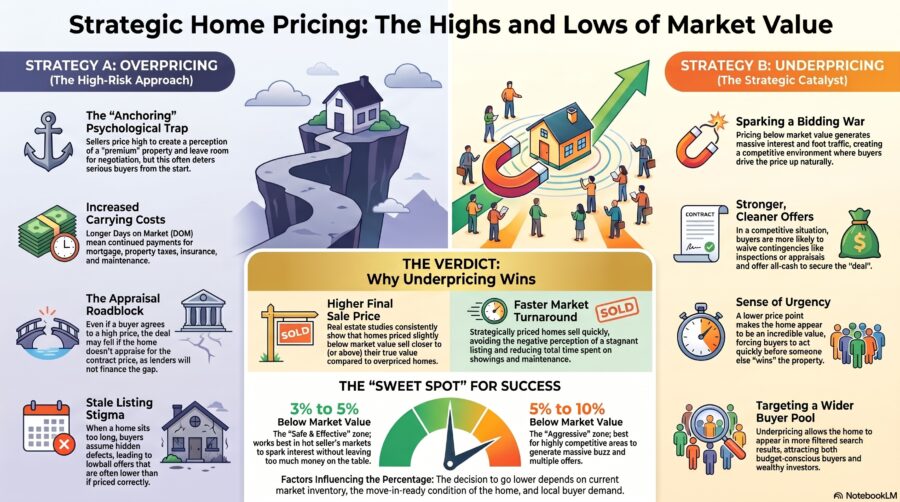
In the world of market dynamics, pricing high is often defended through the “Anchoring Effect.” By setting a premium initial price, you provide a psychological reference point. If a buyer sees a home listed at $550,000, a subsequent move to $525,000 doesn’t just feel like a price drop—it feels like a “steal.”
Furthermore, pricing high can be a signal of confidence. It captures high-end buyers who set their search filters above market value, signaling that the home is a “premium” offering. However, this strategy is a double-edged sword. If the home doesn’t deliver on that premium promise, you attract the wrong audience—buyers who expect high-end finishes and a perfect location, only to walk away disappointed when your home doesn’t match the price tag.
When that happens, the “Anchor” becomes an “Albatross”: the Days on Market (DOM) stigma.
“Buyers may perceive the home as more valuable due to the initial high price, influencing their perception of its worth even during negotiations. However, a high DOM count can signal to buyers that something is wrong with the home, leading to lower offers or no offers at all.” — Market Analysis Insider
2. The Hook: Why Listing “Low” Often Leads to Selling “High”
If overpricing is a gamble on perception, strategic underpricing is a play on momentum. This approach treats the listing price as a “hook.” By entering the market slightly below perceived value, you widen the net, catching buyers who might have been priced out of the neighborhood but now see a rare opportunity.
This surge in foot traffic creates a palpable sense of urgency. When a home is perceived as a “great deal,” the psychological fear of missing out (FOMO) takes over. This atmosphere is the primary ingredient for a bidding war, where the competition—not the seller—dictates the final price. In a strong market with limited inventory, this strategy often results in a final sale price that exceeds the “moon shot” number the seller originally considered.
“Pricing below market value is a calculated risk—it works best when there’s strong demand and limited inventory. However, in a slow or buyer’s market, underpricing without sufficient interest could lead to low offers without the benefit of competition.” — Industry Standard Report
3. The Hidden Appraisal Safety Net
One of the most overlooked risks of overpricing is the “failed deal.” If a home goes under contract for an inflated price, it still has to survive the appraisal. If the bank decides the home isn’t worth the contract price, the buyer’s financing may collapse, forcing the seller back to square one with a now-stale listing.
Strategic underpricing creates an “Appraisal Safety Net.” Because the price rises naturally through competition, the final number is more likely to align with current market activity. Furthermore, buyers in a bidding war are statistically more likely to submit “cleaner” offers. To win the house, they often waive inspection contingencies or provide “appraisal gaps”—promising to pay the difference in cash if the bank’s valuation comes in low. In short, underpricing simplifies the transaction and protects the seller from the eleventh-hour heartbreak of a financing failure.
4. Finding the “Sweet Spot”: The 3% to 10% Rule
To move from theory to action, we look at the data-driven tiers of underpricing. For a home with a market value of $500,000, the strategy breaks down into three distinct risk profiles:
- The “Sweet Spot” (3% to 5% Below Value): Listing at 475,000–485,000. This is the safest and most effective range for most markets. it attracts a wide pool of buyers while keeping the price grounded enough to ensure any bidding war remains within a realistic appraisal range.
- The Aggressive Strategy (5% to 10% Below Value): Listing at 450,000–475,000. This is recommended for “fast-moving inventory” in highly competitive areas. The goal is to generate maximum “buzz,” often leading buyers to waive all contingencies to secure the property in a buying frenzy.
- High Risk (10%+ Below Value): Listing at under $450,000. This is generally reserved for distressed properties, unique fixer-uppers, or ultra-hot “unicorn” markets. If the buyer pool is shallow, you risk selling for less than the home’s worth; if the pool is deep, you create a frenzy.
5. The High Cost of Sitting Still
A home that sits on the market isn’t just a missed opportunity; it’s a mounting expense. Every week your listing lingers, you accrue “Carrying Costs”: mortgage interest, property taxes, insurance, and maintenance.
Worse yet is the risk of an “Expired Listing.” If your home doesn’t sell within the agreement period, it disappears from the market only to be relisted later. By then, the damage is done. Buyers assume the property is unmarketable or “tainted,” leading to lowball offers that reflect your perceived desperation. Paradoxically, the seller who tries to hold out for the highest price often ends up with the least amount of money in their pocket.
“Overpricing is risky and often backfires, leading to longer market times and lower final sales prices. Buyers may assume something is wrong and hesitate to bid aggressively.” — Final Verdict, Property Advisory Group
Conclusion: The Market is the Ultimate Judge
While the “Anchoring Effect” can capture a high-end buyer in a desperate, low-inventory market, the statistical advantage belongs to the strategic underpricer. Momentum is the most valuable currency in real estate. A home that hits the market with a competitive “hook” generates the energy required to drive prices upward, while an overpriced listing spends its energy fighting against gravity.
In a market that rewards speed and competition, you have to ask yourself: Are you willing to risk the stigma of a stale listing for the sake of a higher starting number, or will you let the buyers compete to tell you what your home is worth?
