

 1. Introduction: A Step Back into “El Pueblo Fiel”
To walk the brick-lined streets of Ybor City today is to navigate a surreal intersection of eras. Wrought-iron balconies and 19th-century industrial architecture frame a district where wild roosters boldly cross the tracks of a modern streetcar line, and the scent of roasting coffee mingles with the legacy of revolutionary politics. Known historically as “El Pueblo Fiel” (The Faithful Town), Ybor City was founded on a spirit of resilience and intense loyalty—first to the craft of the cigar, and later to the cause of liberty. It remains a place where a century of history hasn’t been polished away; instead, it lives and breathes in the calls of its feral chickens and the enduring glow of its nightlife.
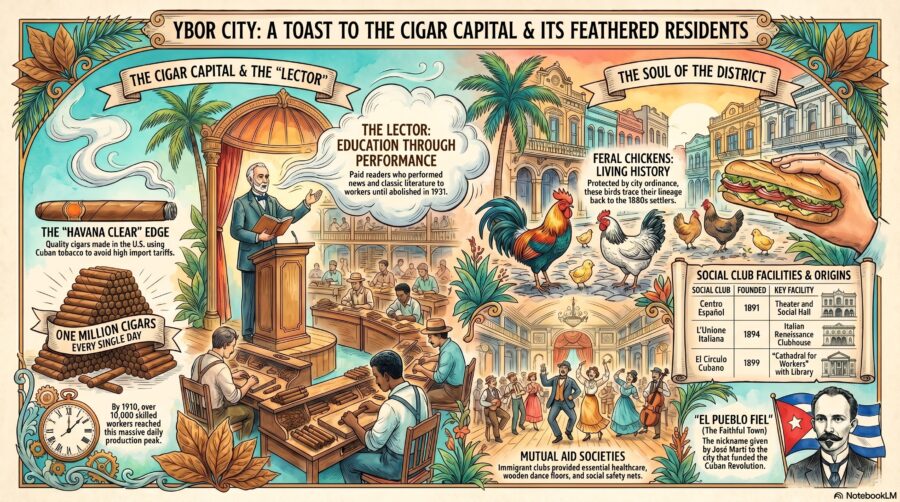
2. The “Havana Clear” Loophole: How a Border Hack Built an Empire
The transformation of a “remote dirt plot” into the “Cigar Capital of the World” was born of political necessity and economic genius. In the late 19th century, Vicente Martínez Ybor was a prosperous manufacturer in Cuba, but the outbreak of the Ten Years’ War in 1868 placed his business—and his life—in jeopardy. After the Spanish government questioned his loyalty and issued a warrant for his arrest due to his revolutionary sympathies, Ybor fled to Key West and eventually to a “low area spotted with marshes and lagoons” northeast of Tampa.
Ybor’s masterstroke was the “Havana Clear” method. By importing raw Cuban tobacco and employing skilled Cuban laborers to hand-roll cigars within the U.S., he bypassed the high tariffs levied on finished tobacco imports. To ensure labor stability and discourage workers from migrating back to Cuba, Ybor didn’t just build a factory; he built a “company town.” He constructed casitas (small frame houses) and sold them to his workers at cost on interest-free installment plans. This strategy anchored a world-class workforce to a patch of Florida scrubland, turning a marshy wilderness into an industrial behemoth.
“The jewel of Ybor City and Vicente Martinez Ybor’s passion project, the Ybor Cigar Factory was a massive 3-story structure. The factory was believed to be the largest in the world at the time and was renowned for its beauty.” — Tampa Historical
3. The Human Radio: The Rise and Tragic Fall of the “Lector”
One of the most sophisticated cultural institutions of the cigar industry was the Lector, or factory reader. To occupy their minds during the repetitive labor of hand-rolling, workers contributed 25 to 50 cents of their weekly wages to hire a Lector. This individual sat upon an elevated platform, serving as a “human radio” for a workforce that possessed an enormous potential for education.
The Lector was a performer, required to “read with feeling” (leer con sentido) and act out scenes with dramatic flair. The content was decided democratically; workers would vote on a selection of four or five novels, with classics by Zola, Tolstoy, and Pérez Galdós enjoying immense popularity. However, the institution became a threat to management as the Great Depression intensified. In December 1931, accusing the readers of disseminating “anarchistic propaganda,” factory owners abolished the practice. In a final stand for their “proletarian tradition,” workers refused a management offer to reinstate the Lectors if the owners could choose the material. They preferred silence to censorship.
“The lector during the period in which I read did not have the benefit of a loud-speaker system. It was all through the strength of one’s voice (fuerza de grito). In one factory… one had to read loud enough to be heard by everyone. It was an enormous effort.” — Abelardo Gutiérrez Díaz, Lector
4. War in a Wrapper: The Secret Message that Sparked a Revolution
Ybor City was the strategic hub for Cuban independence. The “Apostle of Cuban Independence,” José Martí, visited the district 20 times, finding the “purpose and security” to unite revolutionary factions. He was frequently hosted by Paulina Pedroso, a prominent Afro-Cuban patriot whose home became a sanctuary for Martí after an attempt on his life.
The connection between Ybor and the revolution reached its zenith in 1895. Martí signed the order for the uprising in New York and directed it to Tampa. There, the order was rolled into a cigar by a cigar magnate named O’Halloran. This hand-rolled decree was smuggled from Tampa to Key West via steamship, and then into Cuba, where it was opened by Juan Gualberto Gomez. This “war in a wrapper” officially initiated the Cuban War of Independence on February 24, 1895.
5. The Feathered Immigrants: Why Chickens Rule the Streets
The feral chickens of Ybor City are “living history.” They arrived in the late 1800s, brought by workers from Key West and Cuba who were seeking employment after a massive fire decimated Key West’s factories. Originally kept as backyard livestock for meat and eggs, the birds transitioned from food sources during the Great Depression to protected urban icons. Today, they are safeguarded by the Tampa Bird Sanctuary Law and cared for by the Ybor Chicken Society.
Feathered Facts:
- Ancient Lineage: They share a prehistoric ancestry with the Tyrannosaurus Rex.
- Cognitive Skill: These birds can recognize and remember up to 100 individual human faces.
- Legal Protection: A decades-old Tampa ordinance makes it unlawful to hunt, kill, or trap birds within city limits.
- Economic Impact: Approximately 30% to 40% of local Ybor businesses use the chickens in their branding or logos.
6. Taste and Nightlife: A Modern Walk Down 7th Avenue
Modern Ybor City honors its heritage through a blend of “Old World” staples and new ventures. The “soul” of the district remains its historic social clubs, such as the Cuban Club and Centro Español, which were established as mutual aid societies to provide a community infrastructure that the cigar factories could not. A stroll down 7th Avenue reveals a landscape of brick streets and iron balconies where the tradition of the “nail in the doorframe”—where fresh Cuban bread was once impaled for morning delivery—is still remembered at the Ybor City Museum State Park, housed in the historic Ferlita Bakery.
| The Tradition | Where to Experience it Today |
| Hand-baked Cuban Bread | La Segunda Central Bakery |
| “Havana Clear” Heritage | J.C. Newman Cigar Co. (El Reloj District) |
| Social Club “Soul” | The Cuban Club / Centro Español |
| Historic Ovens & “Casita” Tours | Ybor City Museum State Park (Ferlita Bakery) |
| Cultural Dining & Flamenco | Columbia Restaurant (Oldest in Florida) |
| Modern Craft Brewing | BarrieHaus Beer Co. / Coppertail Brewing |
7. Conclusion: The Resilience of the “Misfit” District
Ybor City remains a “misfit” community—a term that once described the political radicals and immigrants seeking sanctuary, and today describes the “misfit” chickens cared for at the Ybor Misfits Microsanctuary. It is a multifaceted district that refuses to lose its identity to unchecked development. By protecting its wild birds as fiercely as it once fought for its cigars and its freedom, Ybor serves as a living museum of urban resilience.
In a world of cookie-cutter neighborhoods, what can we learn from a community that fights as hard for its wild chickens as it once did for its cigars and its freedom?
