

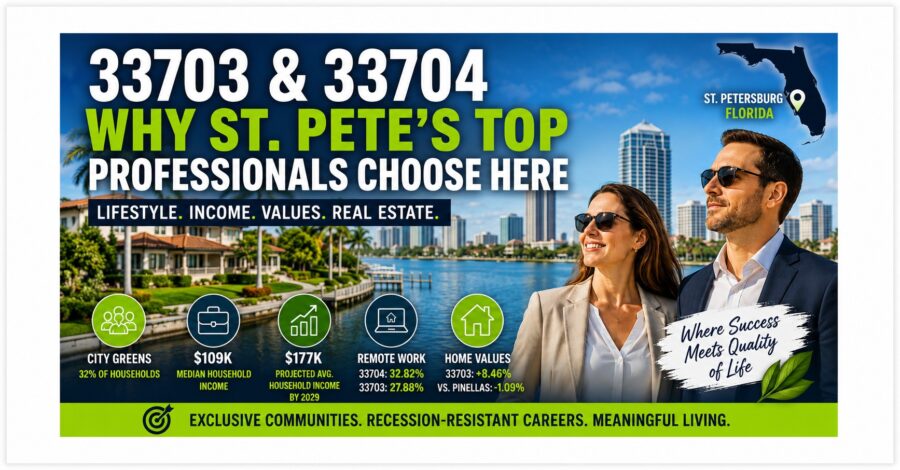
 For the high-earning executive or the specialized consultant, a residential relocation is rarely just about square footage; it is a calculated pursuit of “market alpha” in one’s personal life. In St. Petersburg, Florida, this strategic calculation leads almost exclusively to the 33703 and 33704 corridor. These zip codes have become the premier hubs for those seeking a rare synergy of urban proximity and suburban tranquility. At the heart of this movement is the “City Greens” consumer segment—a demographic that prioritizes both career excellence and environmental stewardship.
Shared Identity: The Dominance of the “City Greens”
The sociocultural fabric of 33703 is defined by the “City Greens” segment, which accounts for a significant 32.0% of all households. This group represents a highly educated, dual-income vanguard where more than 54% of residents hold a bachelor’s or graduate degree.
These professionals are drawn to the “Urban Vicinity” character of the area, favoring established, high-value single-family homes, many of which date back to the pre-1970s era. This preference for “character” properties over cookie-cutter developments reflects a broader value system rooted in community and civic engagement.
“Residents tend to engage with a variety of causes. They vote regularly, participate in environmental groups, and recycle, and they often spend time outdoors.”
The Professional Pulse: Recession-Resistant Industry Alignment
The economic profile of 33703 confirms its status as an elite professional enclave. The area’s Median Household Income of 109,139 is not merely high; it is a profound outlier when contrasted with the Pinellas County average (75,860) and the broader Florida average ($78,210). Looking ahead, the Average Household Income is projected to surge to $177.15K by 2029.
This wealth is anchored in what I classify as recession-resistant sectors. With a robust 71.4% labor force participation rate, the community is powered by:
- Professional, Scientific, and Technical Services: 1.9K employees
- Health Care and Social Assistance: 1.78K employees
- Education: 1.51K employees
- Finance and Insurance: 1.32K employees
By concentrating in these specialized fields, residents have created a community of like-minded peers, ensuring both socioeconomic stability and high-level networking opportunities.
The Remote Work Divide: 33704 vs. 33703
While both zip codes are top-tier, a nuanced divide exists in their work-life structures. Zip code 33704 maintains a higher remote work rate of 32.82%, compared to 27.88% in 33703.
As a strategist, I attribute 33703’s lower remote work percentage to its demographic maturity. The area features a heavy concentration of the “Mature and Retired Living” life stage group—specifically the “Burbs and Beyond” (Rank 2) and “Top Tier” (Rank 5) segments. These residents are often in the “post-remote” phase of their lives or are senior-level healthcare and education leaders whose roles demand a physical presence. Conversely, 33704’s higher rate suggests a more tech-integrated, flexible professional base in the earlier stages of their career peaks.
Values-Based Living: Wellness as a Professional Discipline
For the “City Greens” and “Urban Chic” residents, wellness is an extension of their professional discipline. Their lifestyle patterns indicate a rejection of convenience-based consumption in favor of conscious, high-quality living. They are politically active, cause-oriented, and prioritize physical longevity.
“Residents tend to exercise frequently, schedule regular checkups, and eat fresh, organic foods.”
This commitment to health and fresh, organic nutrition isn’t just a trend; it is a core identifier of the St. Pete professional.
Real Estate Resilience: Market Alpha in Motion
The real estate data for 33703 provides a compelling “buy” signal for investors and homeowners alike. While Pinellas County and the state of Florida saw a 12-month change in Median Estimated Home Value of -1.09% and -2.06% respectively, 33703 defied the trend with a +8.46% increase.
With a median listing price of 500K and a significant “Top Tier” segment (9.3% of households) boasting a Median Net Worth of **1,734,059**, the area represents a massive concentration of capital. This wealth drives a secondary economy of personal services—including financial planners, personal chefs, and gardeners—and a continuous cycle of “large remodeling projects” as residents aggressively reinvest in their properties.
Conclusion: The Move Toward Exclusivity
The trajectory for the 33703/33704 corridor is one of increasing exclusivity. While the total population is projected to see a slight decline—from 23.61K in 2025 to 23.48K in 2029—this should not be mistaken for a loss of interest. Combined with a decreasing average household size (from 2.17 to 2.14) and rising incomes, this indicates a clear shift toward higher wealth density.
The “City Green” lifestyle—a sophisticated blend of career excellence, environmental stewardship, and health-conscious living—is more than a local preference; it is the new blueprint for modern urban living. For those navigating the St. Pete market, 33703 and 33704 are no longer just neighborhoods; they are strategic anchors for the high-achieving professional. One must ask: is your current residence providing this level of lifestyle ROI?
