

 The “Perfect Life” Mirage
For the modern tech professional, the dream of prosperity often leads to a high-stakes crossroads: the high-performance “Data Center Alley” of Ashburn, Virginia, or the “Sunshine City” of St. Petersburg, Florida. On paper, Ashburn offers the ultimate proximity to the global digital engine. Yet, a growing number of high-net-worth families are questioning the logic of a $850,000 mortgage for a home sitting in the literal shadow of an airplane-sized server hub. While both regions promise prosperity, the day-to-day realities—from hidden infrastructure costs to environmental stressors—are worlds apart. Is the prestige of Northern Virginia worth the “industrial” tax on your lifestyle, or is the Gulf Coast’s promise of a refined coastal sanctuary the smarter socio-economic play? Choosing between them requires looking past the real estate brochures and into the raw municipal data of these two diverging American realities.
Living in an Internet Hub vs. a Cultural Hub
Ashburn’s identity has undergone a radical industrial evolution. Once a “charming rural town,” it has transformed into a landscape dominated by “lifeless buildings the size of airplane hangars.” This shift has profound psychological impacts; residents navigate a town where 70% of the world’s internet traffic passes through massive, windowless hubs that operate 24/7. This “industrial urbanity” creates a sterile environment that can feel more like a utility grid than a neighborhood.
In contrast, St. Petersburg is architecturally and socially designed as a lifestyle destination. Utilizing “Urban Core” and “Urban Vicinity” planning, the city emphasizes “City Greens” and “Suburban Shine” segments. While Ashburn residents look out at windowless server farms, those in the Gulf Coast occupy a space defined by beautiful treeline streets and Mediterranean architecture. The demographic focus in St. Pete is on “Mature and Retired Living”—a refined phase of life that prioritizes fine dining and outdoor activities over the 24/7 hum of the cloud.
“Ashburn, the quiet family-focused suburb of Washington D.C., has developed into a data center disaster. Warm and welcoming homes and parks are being choked out by lifeless buildings the size of airplane hangars that are effectively controlling most of our modern world.” — Keaten Calic and Abby Daggitt
The Utility Bill Shock (It’s Not Just the Mortgage)
The financial burden of relocation often hides in the monthly line items. In Ashburn, the massive power demand of data centers has directly cannibalized residential resources. Utility grid operators are building new infrastructure to accommodate this digital thirst, causing the average consumer to pay 37% more for electricity since 2020.
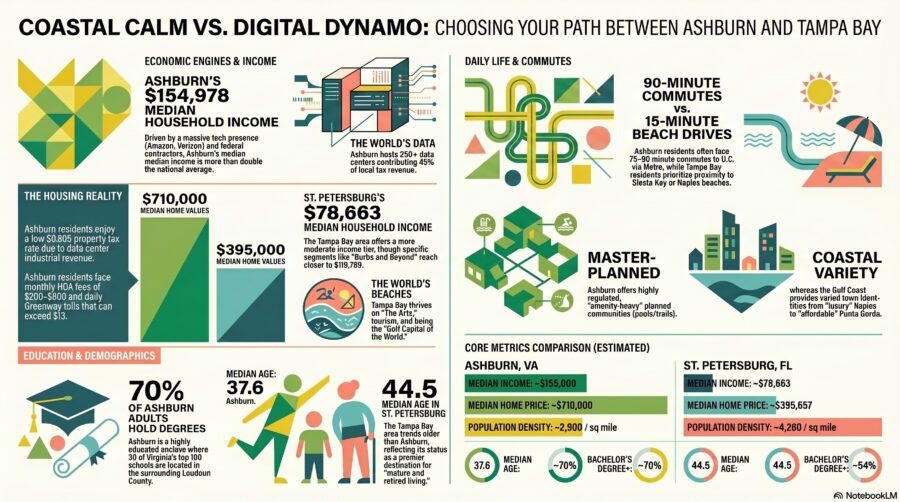
In St. Petersburg, while the median household income of 78,663** is lower than Ashburn’s tech-inflated figures, the net worth distributions suggest a more stable form of wealth. For example, the “Burbs and Beyond” segment boasts a median net worth of **779,483. However, the economist must note the high “Rent Burden” in St. Pete, which ranges from 33% to 46% depending on the neighborhood segment.
Socio-Economic Expense Profile:
- Ashburn, VA (The Growth Flux):
- Loudoun Car Tax: $400+ annually per vehicle.
- Dulles Greenway Tolls: $13+ daily for a standard commute.
- Utility Inflation: 37% electricity hike driven by industrial data center demand.
- HOA Fees: 600–800/month in high-amenity communities like Brambleton.
- St. Petersburg, FL (The Maintenance Phase):
- Property Maintenance: High capital expenditure on “Large Remodeling Projects” for older housing stock.
- Rent Burden: 33–46% of households are classified as rent-burdened.
- Financial Diversification: High rates of regular IRA contributions and use of financial advisors.
“The tax breaks that they [data centers] were initially given are now being outweighed by the impact that it’s having on the environment, communities, and neighborhoods with the water and the electric drop in the grid.” — Kevin Winsheimer
The 3-Hour Commute vs. the Golf Cart Lifestyle
In Ashburn, “Location Promise” rarely matches the “Commute Truth.” Marketing suggests easy access to D.C., but the reality of the Silver Line is a 75–90 minute peak-hour journey. Driving is equally taxing, with Route 7 frequently exceeding 65 minutes of congestion.
Conversely, St. Petersburg’s “Emerging Hub” demographic benefits from a 74% labor force participation rate with high levels of remote work. The urban layout allows for a “golf cart friendly” lifestyle in communities like Dunedin, where residents can navigate their entire daily routine without a major highway. In St. Pete, tech professionals prioritize being within 15 minutes of world-class beaches, effectively trading “weekday chaos” for a 15-minute bike ride or walk to work.
“I thought walking to the Metro would be a game-changer. First week in, I texted Atif: ‘Bro, I’ve been standing for an hour. I’m one podcast away from calling an Uber.'” — Mike K.
The School Boundary Gamble
Families moving to Ashburn for Loudoun County’s top-tier schools face a significant “Education Gamble.” Data indicates that 30% of Ashburn families face school rezoning within just two years. Boundary lines move “like sand,” creating institutional instability for parents who paid a premium for a specific district.
St. Petersburg represents a more mature demographic in a “maintenance and refinement” phase. With a median age of 44.5 and a dominant “City Greens” segment, the community is characterized by civic stability. These residents engage with causes, vote regularly, and recycle, fostering a settled environment rather than the rapid, unpredictable growth and redistricting that defines the Northern Virginia tech corridor.
Industrial Thirst vs. Gulf Coast Waters
The environmental contrast is staggering. A single hyperscale data center in Ashburn can consume 5 million gallons of water a day—the same amount required by a town of 50,000 residents. This industrial consumption, paired with the air pollution from gas-fired generation and diesel emergency generators, creates a hidden health tax for Northern Virginia residents.
St. Petersburg’s “City Greens” demographic (ranking 1st in dominance at 15.9%) prioritizes environmental health and preservation of the Gulf Coast. Their lifestyle revolves around the water, but through the lens of conservation and recreation rather than industrial cooling. In St. Pete, the “Diversity Index” of 66.7 in emerging hubs reflects a vibrant, heterogeneous community focused on the quality of the natural world.
“Recent estimates project that by 2028, AI-related data centers in the U.S. could require up to 32 billion gallons of water annually. This is enough to support roughly 360,000 households’ indoor water use.” — Carla Walker and Ian Goldsmith
Conclusion: Choosing Your Perspective
The decision to relocate is ultimately a choice between two versions of American prosperity. Ashburn is a “cloud powerhouse,” a high-octane environment for those chasing the peak of the digital economy with a median home entry point of 791,000**. St. Petersburg offers a “refined lifestyle” with significantly lower median home prices, ranging from **395,000 to $466,000 depending on the specific neighborhood segment.
Are you moving to fuel the digital economy, or are you moving to find a place where the only thing being processed is the sunset over the Gulf?
