

 1. Introduction: The Pirate Who Wasn’t There
Every January, the saltwater of Hillsborough Bay is churned into a white froth by the weight of a century-old tradition. A 165-foot, three-masted vessel—bristling with cannons and draped in the black-and-white iconography of the skull and crossbones—leads a sprawling flotilla toward the heart of downtown Tampa. This is the Gasparilla Pirate Fest, an explosion of maritime pageantry that has swelled to become the third-largest parade in the United States. To the casual observer, the scene is a visceral connection to Florida’s lawless past, a reenactment of the life and dramatic 1821 suicide of José Gaspar, the “Last of the Buccaneers.”
Yet, if one peels back the layers of costume jewelry and manufactured antiquity, a surprising historical vacuum emerges. Despite its status as a cornerstone of Florida culture, the legend of José Gaspar is built entirely upon a phantom. There are no Spanish naval records of his service, no American ship logs of his captures, and no physical traces of his supposed “pirate kingdom” in the Charlotte Harbor area. The man who defines Tampa’s identity is not a ghost of history, but a masterful construction of early 20th-century marketing.
2. The “Cockeyed Lie” that Launched a Tradition
The birth of José Gaspar did not occur on the high seas, but in the sterile marketing offices of the Charlotte Harbor and Northern Railway Company. In the early 1900s, publicist Pat Lemoyne was tasked with a distinctly modern challenge: how to draw tourists to the newly opened Gasparilla Inn in Boca Grande. Seeking to imbue the burgeoning, scrub-filled region with a “romantic” allure, Lemoyne authored a promotional brochure detailing the exploits of a nobleman-turned-outlaw.
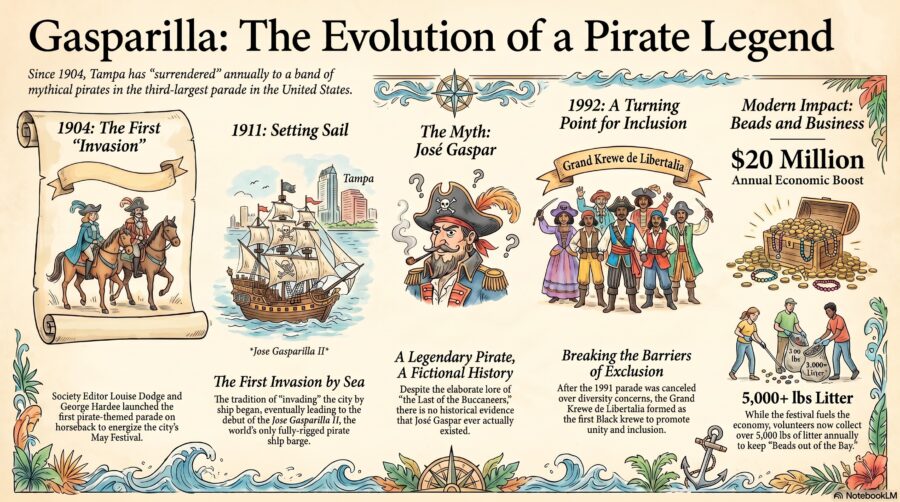
This marketing tactic was a stroke of civic alchemy. In 1904, Tampa’s business elites, looking to spice up the city’s mundane May Day festivals, adopted Lemoyne’s fiction as their own. It was a trade-off that favored fantasy over the mundane reality of Florida’s agricultural growth. The myth took such aggressive root that by 1949, when a retired Lemoyne finally pulled back the veil, the city was already too deeply in love with its pirate to care about the truth. During a lecture to the Fort Myers Chamber of Commerce, Lemoyne cheerfully confessed to his invention:
“A cockeyed lie without a true fact in it… tourists like to hear [it].”
The implication is profound: Tampa chose a colorful lie over its own history because the lie was “good for business.” In doing so, a marketing brochure for a railroad company managed to define a major American city’s identity for over a century.
3. The Names Precede the Legend
In the attempt to legitimize the legend, proponents often point to the maps of the Florida coast as a sort of geographical witness. Names like “Gasparilla,” “Captiva,” and “Sanibel” are frequently cited as proof of Gaspar’s presence—Captiva being the supposed site where he held his female captives.
Intellectual curiosity, however, reveals a chronological impossibility. These names appear on maps decades before Gaspar was ever supposed to have set foot in the Gulf. An unidentified map from 1772 and the famous 1774 Bernard Romans map both clearly label “Boca Gasparilla” and “Captiva” years before Gaspar’s alleged career began in 1783.
Historians have since proposed the “Friar Gaspar” hypothesis, suggesting the islands were actually named after a Spanish missionary priest who visited the Calusa Indians in the 1600s. The etymology supports the pacifist over the pirate; the Spanish suffix “-illa” is a feminine diminutive. While “Little Gaspar” or “Gentle Gaspar” is a fitting title for a friar, it is a curiously soft nickname for a bloodthirsty buccaneer who supposedly amassed $30 million in plunder.
4. The Ship is a Masterful Illusion
The centerpiece of the annual invasion is the Jose Gasparilla II, a vessel that captures the imagination with its towering masts and weathered rigging. But like the man it honors, the ship is a product of modern engineering disguised as ancient history.
The first “invasion” in 1904 didn’t even feature a ship; the pirates arrived on horseback. When they did take to the water, they used borrowed vessels—including the curiously named Octopus in 1904. It wasn’t until 1937 that the Krewe acquired their first owned vessel, the Jose Gasparilla I. The current iteration, the Jose Gasparilla II, debuted in 1954 for the festival’s 50th anniversary.
Technically, the ship is a masterful deception. It is a flat-bottomed, steel barge with no engines and no means of self-propulsion. It is incapable of navigating the bay on its own and must be painstakingly moved by a fleet of tugboats. The centerpiece of Tampa’s grandest tradition is, quite literally, a floating stage—a construction of steel built to sustain a construction of folklore.
5. The 1991 Crisis: When Tradition Met Progress
Gasparilla’s history has not always been a story of unity. For decades, the festival functioned as an exclusive social club event, reflecting the era’s segregation and social stratification. This came to a volatile head in 1991, when the parade was canceled following intense public pressure for the Krewes to diversify their memberships.
In place of the pirate invasion that year, the city hosted a street carnival called Bamboleo. The temporary absence of the pirates served as a catalyst for genuine social change. In 1992, the Grand Krewe de Libertalia was founded as the first Black Krewe to participate in the festival, taking their name from a mythical pirate colony based on equality. Their inaugural float featured a black and white hand joined in unity, a visual manifesto that signaled the festival’s transition from an exclusive elite gathering to a diverse community celebration.
6. The Heavy Price of Plastic “Plunder”
While the fictional José Gaspar sought gold and silver, the modern festival leaves behind a different kind of treasure: millions of plastic beads. This “plastic plunder” has led to the “Beads in the Bay” crisis, an environmental reality that contrasts sharply with the festival’s celebratory atmosphere. Because these beads are made of non-decomposable plastic, they pose a lethal threat to the local marine ecosystem.
The scale of the aftermath is staggering. Each year, volunteers collect roughly 5,000 pounds of trash and beads from the streets and waterways. This has sparked a new wave of local ingenuity. The Florida Aquarium now offers a 50 percent admission discount for bead donations, while the MacDonald Training Center manages a recycling program that employs individuals with disabilities to clean and repackage the “plunder.” These initiatives represent a modern attempt to reconcile a 19th-century fantasy with 21st-century environmental responsibility.
7. Conclusion: A Legacy Built on Imagination
Today, Gasparilla is an undeniable economic titan, generating approximately $20 million in annual activity and serving as the premier marketing tool for the Tampa Bay area. It is a spectacle that draws hundreds of thousands to witness a legend that never happened.
Ultimately, the fact that José Gaspar never existed is the most fascinating part of his story. It highlights a unique power of city-building: the ability of a community to take a “cockeyed lie” and weave it into the fabric of its soul. Does it matter that the pirate was a publicist’s invention? Perhaps not. While the buccaneer himself is a fiction, the history he inspired, the economic growth he fueled, and the community unity born from his myth are entirely, undeniably real.
