

 Long Island, NY vs. Tampa, FL: Which Place Fits Your Life Better?
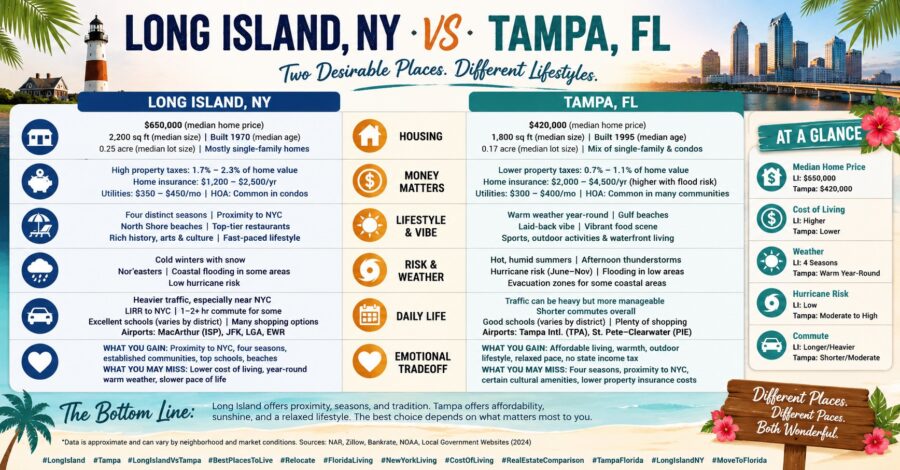
Choosing between Long Island and Tampa is really a choice between Northeast convenience and tradition versus Florida warmth and lifestyle flexibility. Long Island gives you proximity to New York City, established suburbs, strong schools, beaches, four seasons, and higher housing costs. Tampa offers year-round warm weather, lower home prices, no Florida state income tax, a growing city lifestyle, and higher hurricane/flood-insurance awareness.
Housing
Long Island is generally the more expensive housing market. Redfin’s Long Island market page recently showed a median sale price around $745,000, with a median price per square foot around $454. Tampa’s median sale price was much lower, around $432,500 in March 2026. (Redfin)
Long Island homes are often older, especially in Nassau and western Suffolk, with many postwar capes, colonials, ranches, split-levels, and established single-family neighborhoods. Lots can feel more suburban than urban, but prices rise sharply near train lines, beaches, top school districts, and the North Shore or Hamptons.
Tampa has a wider mix: bungalows, new construction, townhomes, condos, waterfront homes, and master-planned communities. You may get a newer home or more modern layout for the money, but neighborhood differences are huge. South Tampa, Davis Islands, Hyde Park, Seminole Heights, Westchase, Carrollwood, and New Tampa all feel very different.
Housing winner for affordability: Tampa
Housing winner for established suburban inventory: Long Island
Money: Taxes, Insurance, HOA, and Utilities
Long Island’s biggest financial pain point is usually property taxes. Nassau and Suffolk homeowners often face high school and local tax bills, even when the mortgage is manageable. New York also has state income tax, while Florida has no personal state income tax. (NY State Tax Dept)
Tampa may look cheaper at first because home prices and income taxes are lower, but insurance can change the math. Florida homeowners insurance remains a major cost variable, especially for older roofs, coastal exposure, flood zones, and wind coverage. Recent insurance estimates vary widely: Insurify lists Tampa homeowners insurance averages around $2,402 annually for one common policy profile, while statewide Florida averages can be much higher depending on coverage assumptions. Long Island insurance averages are also elevated in coastal areas, with Insurify estimating Long Island around $2,840–$2,882 annually for a $300,000 dwelling policy profile. (Insurify)
HOAs are more common in Tampa condos, townhome communities, and planned neighborhoods. Long Island has fewer HOAs in traditional single-family neighborhoods, but condos, co-ops, and gated communities can still carry monthly fees.
Money winner for income tax and purchase price: Tampa
Money warning: Tampa insurance and flood coverage must be quoted before assuming big savings
Money warning for Long Island: property taxes can be the deal-breaker
Lifestyle
Long Island gives you four seasons, proximity to NYC, access to the Long Island Rail Road, beaches, boating, vineyards, bagels, diners, pizza, historic villages, and a deeply rooted suburban culture. The lifestyle can feel more established, faster-paced, and neighborhood-specific.
Tampa feels warmer, more casual, and more outdoors-oriented. You get waterfront dining, boating, professional sports, Cuban and Latin food influences, a growing downtown, Ybor City, nearby Gulf beaches, and year-round patio weather. Summers are hot, humid, stormy, and long; winters are mild and are one of Tampa’s biggest lifestyle advantages.
Lifestyle winner for NYC access and four seasons: Long Island
Lifestyle winner for warmth and outdoor living: Tampa
Weather and Risk
Long Island has winter weather, nor’easters, coastal flooding, and hurricane exposure, especially along the South Shore and barrier beach areas. Nassau County and Suffolk County both maintain evacuation and storm-surge tools for residents. (NassauEM)
Tampa has hot, humid summers, frequent thunderstorms, hurricane-season risk, storm surge risk, and flood-zone concerns. Hillsborough County and the City of Tampa both provide tools to check evacuation and flood zones by address. (HCFL)
The key difference: Long Island has storm risk plus winter; Tampa has storm risk plus heat and insurance sensitivity.
Risk winner for fewer hurricanes: Long Island
Risk winner for no snow and mild winters: Tampa
Most important buyer step in both places: check flood zone, evacuation zone, insurance quote, roof age, and elevation before buying
Daily Life
Long Island is highly commuter-oriented. The LIRR runs 24/7 across more than 700 miles of track and connects eastern Long Island to Manhattan, including Penn Station. That is a major advantage for NYC workers, but daily life can include heavy traffic, expensive parking, and long commutes. (MTA)
Tampa is more car-dependent. Commutes may be shorter than Long Island-to-NYC commutes, but traffic on I-275, I-4, the bridges, and major suburban corridors can still be frustrating. Tampa International Airport is a major advantage, offering extensive nonstop service; the airport says it serves over 100 domestic and international destinations. (Tampa International Airport)
Healthcare is strong in both regions. Long Island has access to major New York metro medical systems, while Tampa has major hospitals and specialty care in a growing metro area. Schools vary dramatically by district in both places, so this comparison should be done by exact town, school zone, or ZIP code.
Daily-life winner for NYC commuting: Long Island
Daily-life winner for airport ease and regional mobility: Tampa
Emotional Tradeoff
Moving from Long Island to Tampa can feel like trading intensity for ease. You may gain warmth, lower purchase prices, a more relaxed pace, outdoor living, no state income tax, and a fresh start. You may miss family proximity, NYC access, four seasons, familiar food culture, older neighborhoods, and the identity that comes with Long Island living.
Moving from Tampa to Long Island can feel like trading sunshine for roots and access. You may gain stronger NYC connectivity, classic suburbs, seasonal change, and a dense cultural ecosystem. You may miss the palm trees, winter sunshine, lower income-tax burden, and easier outdoor lifestyle.
Bottom Line
Choose Long Island if you value NYC access, four seasons, established suburban communities, strong local identity, and are comfortable with higher taxes and home prices.
Choose Tampa if you want warmer weather, a lower entry price, no state income tax, more year-round outdoor living, and are prepared to carefully manage hurricane, flood, and insurance risk.
The best choice depends less on “New York vs. Florida” and more on your exact lifestyle: commute, family, budget, health needs, tolerance for heat, and how much you value being near New York City.
