

 1. Introduction: Beyond the Postcard
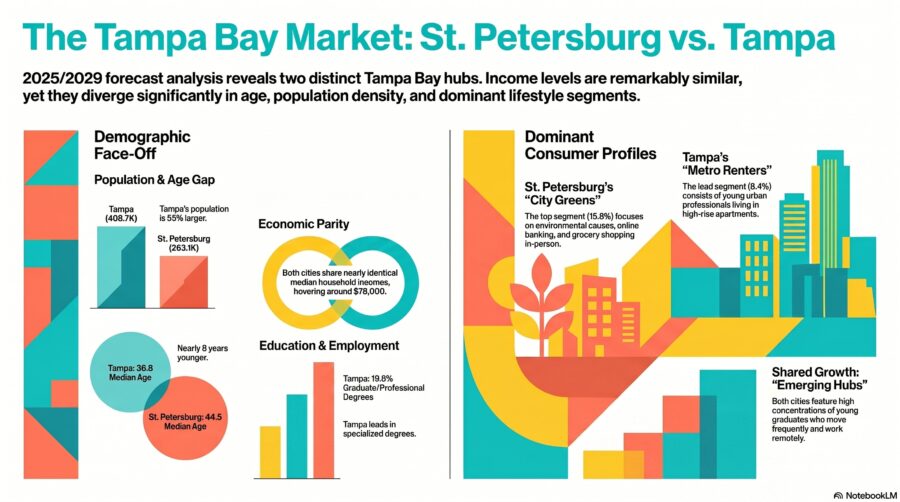
For decades, the cultural shorthand for Saint Petersburg, Florida, was “the newlywed and the nearly dead”—a quiet, sun-drenched retirement enclave. But if you haven’t looked at the data lately, you’re missing one of the most sophisticated urban transformations in the Southeast. Today, St. Petersburg has shed its sleepy reputation to become a high-velocity trade area with a population of 263,134. This isn’t just a place where people come to spend their golden years; it is a city being radically redefined by tech-savvy professionals, wealthy environmentalists, and a “laptop class” that is rewiring the local economy. To understand the modern Gulf Coast, you have to understand the five demographic realities currently reshaping the “Sunshine City.”
2. The “City Greens” Are Taking Over
The most dominant force in St. Pete’s modern identity is a consumer segment known as the “City Greens.” While this group represents a mere fraction of the national landscape, they have found a concentrated stronghold here, dictating the city’s shift toward sustainability and high-end urban living.
In St. Petersburg, 15.9% of households fall into the “City Greens” segment, nearly six times the national average of 2.6%.
These aren’t just casual hobbyists; they are highly educated, wealthy residents with a median household income of $97,516. Interestingly, the secret to this wealth lies in the modern family structure: more than half of these households are powered by dual incomes. They are tech-literate and environmentally conscious, yet they retain a charming lifestyle quirk—despite banking and shopping online, they overwhelmingly prefer to buy their groceries in person. This preference for the tactile and the local is exactly why the city’s character has shifted toward walkable neighborhoods and vibrant, eco-friendly infrastructure.
3. A Remote Work Powerhouse
While the national conversation remains divided on the “return to office,” St. Petersburg has already voted with its feet. Synthesizing commute data with consumer segments reveals a city that has become a sanctuary for flexible labor, particularly within the “Emerging Hub” segment.
Currently, 22.39% of the population works from home. This shift is significant because it directly challenges a deep-seated Florida tradition: the solo commute. Even as 82.52% of the trade area still “drives alone,” the rising remote-work culture is the “mountain” the city’s urban core is currently climbing. In the “Emerging Hub” segment—populated by young professionals in management and computer science—the rate of remote work is significantly higher than average. This lifestyle shift is creating a downtown environment where biking or walking to work is no longer a novelty, but a primary mode of existence for the city’s newest residents.
4. The Looming $11,000 Income Surge
The economic trajectory of St. Petersburg is moving from “stable” to “accelerated.” In 2025, the median household income is a respectable $78,663. However, the four-year outlook suggests a massive influx of wealth and discretionary spending power.
By 2029, the projected median household income for Saint Petersburg is expected to hit $89,920.
This projected surge of more than $11,000 is more than just a local win; it signals that St. Pete is outpacing its neighbors. At nearly 90,000, the city is projected to surpass the median for Pinellas County (87,230) and align perfectly with the state of Florida’s overall projection. This wealth trajectory suggests a healthy, high-earning professional base that is rapidly choosing St. Pete over other traditional Florida hubs.
5. A Tale of Two Wealth Profiles
St. Petersburg is unique in its ability to balance two very different economic life stages. By contrasting the “Burbs and Beyond” and “Emerging Hub” segments, we see a city that caters to both established affluence and upward mobility.
The “Burbs and Beyond” residents represent “Mature and Retired Living,” typically married couples without children living in high-value homes near nature. In contrast, the “Emerging Hub” consists of “Contemporary Households”—younger graduates living in multifamily units who are early in their wealth-building journey.
- Median Net Worth: “Mature and Retired Living” (779,483) vs. “Contemporary Households” (58,291)
- Median Home Value: “Mature and Retired Living” (616,472) vs. “Contemporary Households” (369,687)
This co-existence ensures a diversified real estate market, where luxury remodeling projects and high-end dining thrive alongside a vibrant rental market for the city’s future leaders.
6. The Education Over-Performance
The true engine of the “St. Pete Shift” is a workforce that is significantly more educated than the Florida average. A staggering 27.9% of residents hold a Bachelor’s degree, and 16.37% hold Graduate or Professional degrees, comfortably beating the state averages of 22.5% and 13.54%, respectively.
This intellectual density is remarkably consistent across the city’s top demographics. In fact, more than half of the residents in each of the three dominant consumer segments hold a bachelor’s degree or higher (City Greens at 54%, Emerging Hub at 52%, and Burbs and Beyond at 53%). This “Education Over-Performance” provides a deep talent pool for the city’s primary industries, most notably the 24.18K professionals working in Health Care and the 15.97K experts in the Professional, Scientific, and Technical sectors.
7. Conclusion: The Future of the Sunshine City
The data is unequivocal: Saint Petersburg has successfully transitioned from a retirement haven into a sophisticated urban ecosystem. It is now a unique blend of wealthy environmentalists, remote-working young professionals, and affluent retirees. As the city moves toward a $90,000 median income, its future will be defined by its ability to serve these diverse needs.
The question for the next decade isn’t whether St. Pete will grow, but how it will adapt. How will the city balance its 82.52% “drive alone” reality with a population that increasingly demands the ability to bike, walk, and work from home? For those watching the Gulf Coast, the answer to that question will determine the next chapter of Florida’s most dynamic trade area.
