

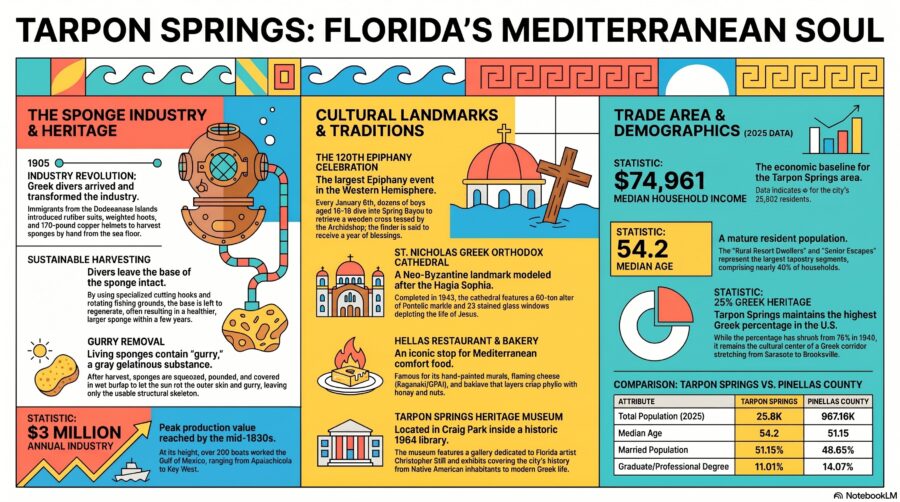
 While most Florida travelers seek the high-octane thrills of Orlando’s theme parks or the sprawling resorts of the Atlantic coast, a different world exists along the banks of the Anclote River. In Tarpon Springs, the typical Florida landscape of palm trees and neon signs gives way to an atmosphere that is undeniably “Old World.” Here, the heavy scent of honey and phyllo wafts from the bakeries on Dodecanese Boulevard, and the rhythmic sound of the Greek language replaces the standard tourist chatter.
The transformation of this Florida bayou into a global industry powerhouse was catalyzed in 1896 by John Cocoris, a native of Arcadia, Greece, who recognized the untapped potential of the Gulf’s sponge beds. Along with the waves of immigrants who followed him, Cocoris helped create a cultural enclave that remains the “Sponge Capital of the World.” As a historian and journalist, I find that the true magic of Tarpon Springs lies in the secrets held beneath the water and within its resilient community.
1. The Biological Secret: Why Harvesting is Good for the Ocean
To the uninitiated, “fishing” for sponges might seem destructive, but the Greek influence in Tarpon Springs established a cycle of sustainability that actually improves the marine ecosystem. Biologically, sponges are aquatic animals, not plants, yet they lack a brain and a central nervous system. This unique biology allows them to be harvested with minimal impact.
The secret lies in the “gurry”—the gelatinous substance found between the sponge’s inner and outer skins. During the harvest, divers use specially designed knives to cut the sponge, ensuring the base remains attached to the seafloor. This allows the organism to regenerate, often growing back larger and healthier within a few years. By rotating fishing grounds, the community ensures no single area is over-taxed.
According to the Acme Sponge Company:
“Scientific studies have consistently confirmed that the regular harvesting of natural sponges actually enhances the health and population of the sponges by increasing the population and removing older sponges.”
2. The 170-Pound Walk on the River Floor
Before the Greek “Revolution” of 1905, the local sponge trade was limited to “hooking”—a shallow-water method where men used long poles to pull sponges from the surface. John Cocoris and his fellow Dodecanese immigrants brought a technological leap that changed the Gulf Coast forever by introducing deep-sea diving.
This transition allowed divers to reach massive, high-quality sponge beds that were previously inaccessible, effectively opening a new frontier of the ocean floor. However, this “revolution” required incredible physical fortitude. Divers descended into the murky depths wearing heavy rubber suits, weighted boots, and massive copper helmets—a traditional rig that weighed over 170 pounds. The physical toll was immense, and the danger of the “bends” or equipment failure was a constant shadow over the lucrative trade.
As historical records from the era note:
This arrival “revolutionized the industry overnight.”
By the mid-1930s, this technology supported over 200 boats, generating $3 million annually and cementing the town’s global reputation.
3. Neo-Byzantine Majesty: A Cathedral of Marble and Miracles
The spiritual heart of Tarpon Springs is the St. Nicholas Greek Orthodox Cathedral, a Neo-Byzantine masterpiece completed in 1943. Modeled in part after the legendary Hagia Sophia, the cathedral serves as a cultural anchor that elevates the town from a mere tourist dock to a significant religious center.
The architecture is a repository of international history. Its 60-ton altar is carved from exquisite Pentelic marble—the same stone used in the Parthenon—and was originally showcased at the 1939 New York World’s Fair. Above the worshippers, three massive chandeliers from Czechoslovakia hang beneath a dome featuring 23 stained glass windows depicting the life of Jesus.
The cathedral is also home to what many believe is a living miracle: the “weeping icon” of Saint Nicholas. In December 1969, moisture was observed on the icon, a phenomenon that continues to draw the faithful and the curious alike to this Florida sanctuary.
4. The High-Stakes Race for a “Year of Blessings”
Every January 6, the tranquility of Spring Bayou is shattered by the largest Epiphany celebration in the Western Hemisphere. This is not merely a festival; it is a high-stakes spiritual pilgrimage that draws nearly 50,000 spectators to watch a display of faith and physical endurance.
The ceremony is steeped in symbolism. This past year, the procession from the cathedral was led by 18-year-old Sylvia Marakas, who carried a white dove representing the Holy Spirit. After the dove was released over the water, the Archbishop tossed a wooden cross into the chilly bayou.
A group of 74 teen boys, all aged 16 to 18, dove simultaneously into the water in a frantic, splashing race. The stakes are profoundly personal: the boy who surfaces with the cross is believed to receive a full year of divine blessings for his family. This year, 18-year-old Athos Karistinos emerged from the water with the cross held high, carried on the shoulders of his peers in a tradition that has survived for 120 years.
5. A Museum Dedicated to Living History
For a deeper look at the community’s soul, the Tarpon Springs Heritage Museum in Craig Park offers a rare “behind-the-scenes” perspective. Eschewing the flash of modern museums, this site—housed in a building constructed in 1964 (often misdated in older records as 1927)—focuses on the authentic stories of the people who built the town.
The museum features an extensive gallery of works by Florida artist Christopher Still, whose cinematic paintings were developed through deep collaboration with local Greek families. What makes this institution unique is its commitment to accuracy and “living history.” It is a place where the staff and visitors learn together; for instance, when a visitor pointed out an exhibit discrepancy regarding a sponge boat’s tiller and rudder, the staff spent the afternoon investigating the technicality with the guest. This dedication to the truth helps tell the story of the town’s resilience, particularly how it survived a devastating mid-century bacterial blight that nearly erased the industry.
——————————————————————————–
Today, Tarpon Springs is experiencing a vibrant rebirth of its sponge beds, proving that the traditions brought by John Cocoris over a century ago were built to last. In a world of fast-paced change and ephemeral attractions, what can we learn from a community that has spent over a hundred years meticulously preserving both its seafloor secrets and its ancestral soul?
