

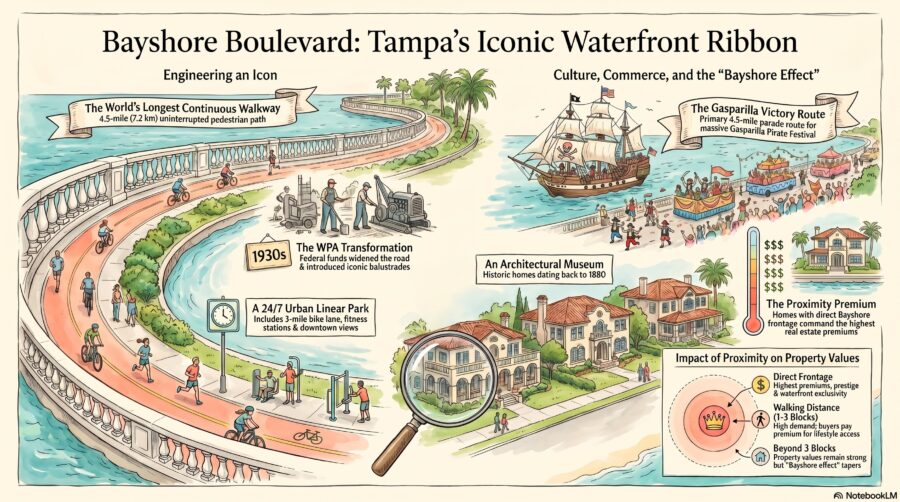
 To the casual observer, Bayshore Boulevard is a postcard rendered in concrete—a shimmering municipal theater where the city’s elite and its most athletic converge. Its iconic white balustrade, possessing a neo-classical aesthetic that feels both ancient and curated, curves gracefully along the waters of Hillsborough Bay. Framed by an emerald median and the architectural trophies of the 33629 ZIP code, this 4.5-mile stretch is often called the “Boulevard of Dreams.” Yet, as any urban historian will tell you, the dreams that built Bayshore were often as manufactured as the land it sits upon. Beneath the serene joggers and the salt spray lies a complex narrative of architectural democratization, marketing myths, and a brutal tension between public beauty and high-speed velocity.
1. The Great Length Debate: A Legacy Superlative
For generations, Tampa’s local identity has been tethered to a specific superlative: the claim that Bayshore Boulevard is the “longest continuous sidewalk in the world.” Even today, organizations like AIA Tampa Bay maintain this status in their architectural guides. However, the data reveals a “local myth versus global fact” tension.
While the sidewalk stretches a formidable 4.5 miles (7.2 km) without interruption from Columbus Statue Park to Gandy Boulevard, it has been eclipsed by Seawall Boulevard in Galveston, Texas. This confusion is rooted in a historical accolade that the city refuses to relinquish—a “legacy superlative” born from an era when Tampa first stepped onto the global stage.
“The longest continuous pedestrian walkway is the 7.2-kilometre-long (4.5 mi) Bayshore Boulevard alongside Upper Hillsborough Bay in Tampa, Florida, USA. It follows the seawall from Columbus Statue Park to Gandy Boulevard without interruption.” — Guinness World Records, 1970
For the “insider” walker, the journey doesn’t actually end where the record does. While the uninterrupted sidewalk technically terminates at Gandy, the path continues another half-mile as the road changes names to Interbay Boulevard, eventually spilling into Ballast Point Park—a secret known primarily to those who prefer the quietude of the Taste of Boston pier to the roar of downtown traffic.
2. The Pirate Who Never Was: A Fictional Scourge
Every January, the Jose Gasparilla II—a 137-foot steel barge disguised as an 18th-century West Indiaman—leads a flotilla across the bay to “invade” the city. This theater, which anchors a $40 million annual economic driver, honors José Gaspar, the “Scourge of the Gulf.”
The archival reality? José Gaspar is a work of pure fiction.
There is no mention of Gaspar in the Spanish Royal Navy archives, no record of his flagship, the Floriblanca, and no evidence of his “pirate kingdom” in the Indian mounds of Boca Grande. The legend was birthed in a 1900 advertising brochure for the Gasparilla Inn, written by publicist Pat Lemoyne. Lemoyne later admitted he embellished regional tall tales attributed to a local fishing guide named “Panther John” Gomez to create a story “in a style that tourists like to hear.”
The story was “without a true fact in it.” — Pat Lemoyne, Publicist
This “tourist-friendly” fabrication has become a structural pillar of Tampa’s culture. From the “Ybor City Navy” attacking U.S. Navy ships with loaves of Cuban bread to the theatrical kidnapping of the mayor, Tampa has built a monolithic civic identity around a ghost.
3. The WPA Legacy: Urban Democratization
Bayshore’s current form is a monumental achievement of the Great Depression. It began in 1914 as a modest one-mile brick drive, but the “elegant promenade” we see today was an ambitious 1930s Works Progress Administration (WPA) project.
Architect Frank Durham and developers Alfred Swann and Eugene Holtsinger had a vision that was radical for its time: the democratization of the shoreline. To ensure the bay remained a public commons, they sold residential properties with the foresight to restrict any building on the water side of the road. This prevented the shoreline from becoming a series of private backyards, preserving the view for every citizen. The WPA project later widened the road and introduced the iconic balustrades, transforming a simple seawall into a monolithic piece of urban art.
4. The “Bayshore Effect”: Real Estate’s Lifestyle Scarcity
In the high-stakes world of South Tampa real estate, proximity to the “Concrete Ribbon” is the ultimate value driver. In the 33629 ZIP code, proximity creates a phenomenon known as “lifestyle scarcity.” According to data from The Lewkowicz Group, demand for this stretch remains resilient even when the broader market softens.
The “Price Premiums by Proximity” are granular and unforgiving:
- Direct Bayshore Frontage: These homes command the highest premiums for exclusivity and the “prestige” of the view.
- 1–3 Blocks Inland: Highly desirable, offering access without the full waterfront price tag.
- Beyond the Fringe: The “Bayshore Effect” begins to taper off significantly after a few blocks, moving back into standard neighborhood pricing.
“People aren’t just buying a home near Bayshore—they’re buying into a daily experience.” — Emeri Lewkowicz, The Lewkowicz Group
5. The Dark Side of the Drive: Velocity and Tragedy
Bayshore’s beauty often masks its brutal velocity. While designed as a scenic linear park, it functions as a major north-south arterial road, creating a lethal intersection between recreation and transit.
The history of the drive is scarred by high-profile tragedies. In 2007, a head-on collision with a shrimp delivery truck littered the road with thousands of crustaceans and shattered the concrete railing. More harrowing are the human costs: the 2018 street-racing crash where a Mustang was clocked at 102 mph before a fatal collision, and the 2020 DUI incident involving a pool supply truck driven by Benjamin Douglas Ehas (with a BAC of 0.234), who veered onto the sidewalk and struck a pedestrian at over 60 mph. These tragedies forced a city-wide reckoning, leading to a permanent speed limit reduction from 40 to 35 mph as the city struggles to balance transit utility with human safety.
6. The “Ribbon of Life”: Estuarine Restoration
For decades, the Bayshore shoreline was “hardened”—a sterile environment of seawalls and rip-rap. Today, the USF Shoreline Restoration Masterplan is working to transform this into a productive estuary, aptly named the “Ribbon of Life.”
Environmentalists have designated Rowlett Park and Blackwater Hammock as “High Priority” sites for the removal of aggressive exotics. The masterplan identifies the Brazilian pepper (Schinus terebinthifolius) and the Air potato vine (Dioscorea bulbifera) as widespread threats that choke out native habitats. By transitioning sections of the shoreline back to a natural state, the city aims to improve water quality and provide refuge for aquatic life.
Native Species Being Reintroduced:
- Smooth cordgrass (Spartina alterniflora)
- Red mangroves (Rhizophora mangle)
- Sea oats (Uniola paniculata)
- Black mangroves (Avicennia germinans)
- White mangroves (Laguncularia racemosa)
A Ponderous Path Forward
Bayshore Boulevard remains a study in calculated contradictions. It is a world-class walkway that is technically second-best; a monument to a pirate who never lived; and a tranquil “natural” shoreline that is, in fact, a modern construction. As Tampa continues its relentless growth, the boulevard stands as its most critical public space. The challenge for the future is whether we can maintain the “iconic” integrity of this path while adapting to the modern demands of safety and environmental restoration. Can a space remain the city’s heart if it must constantly change to stay alive? For now, the walk continues.
